
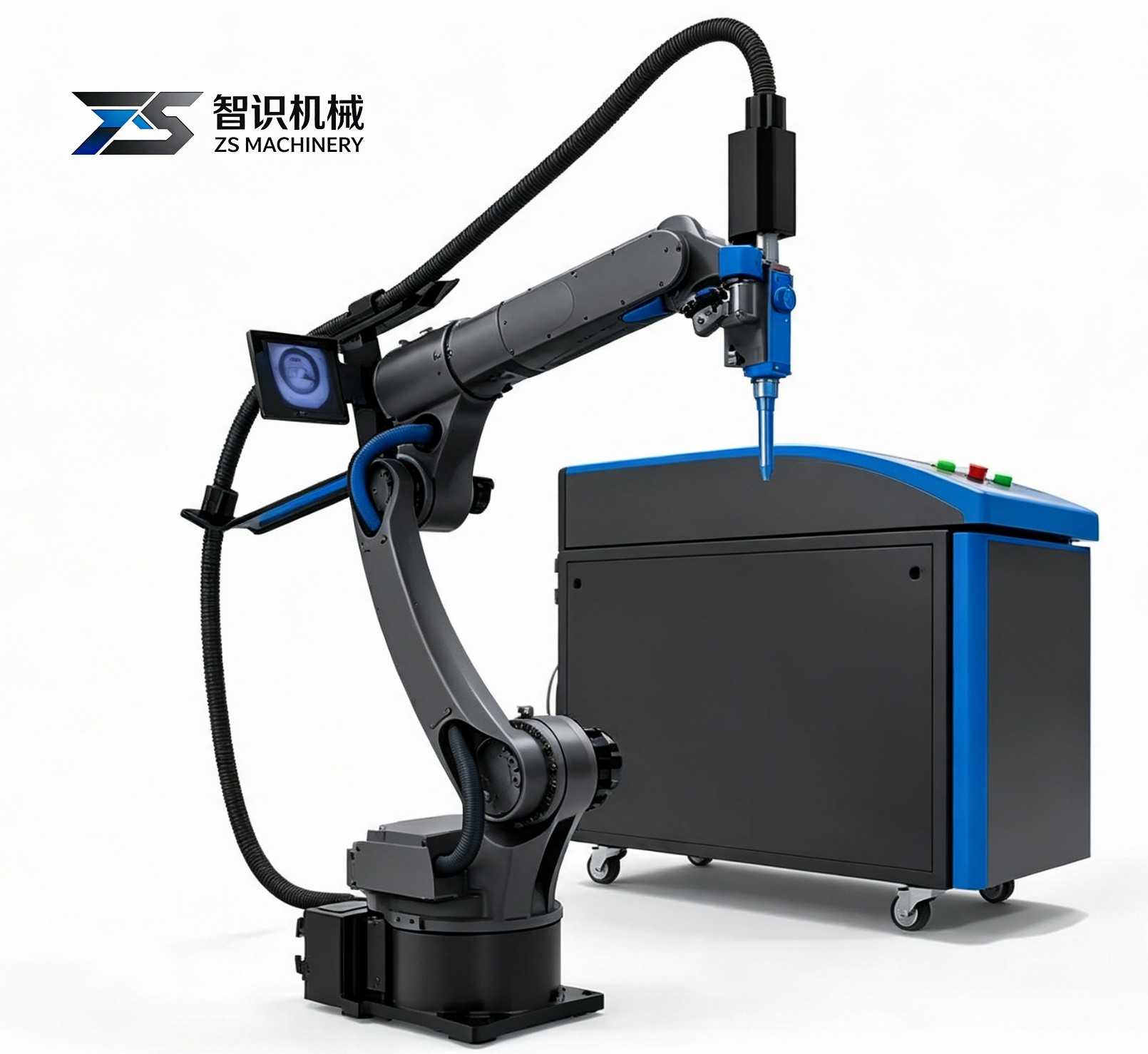
- Product Details
Flexible Robotic Laser Welding for Large and Complex Metal Parts
The 6 Axis Robot Laser Welding Machine combines a six-axis industrial robot with a fiber laser welding system to provide flexible, automated welding for large, irregular, and three-dimensional metal components.
Unlike a conventional CNC laser welding machine that works within the fixed travel range of an XYZ platform, a robotic laser welding system uses a long-reach articulated robot to move the welding head through a much larger three-dimensional working envelope. The robot can approach the workpiece from different directions and adjust the welding head orientation according to the joint geometry.
This makes the system particularly suitable for large workpieces, complex 3D structures, multi-angle welds, tubular components, machinery parts, automotive components, and customized metal assemblies.
6 axis robot laser welding machine
Why Choose a 6 Axis Robot for Laser Welding?
The biggest advantage of robotic laser welding is flexibility.A conventional CNC welding machine moves the welding head along fixed X, Y, and Z travel axes. Its usable welding area is therefore closely related to the platform size and the travel distance of each axis.
A robot works differently. Its articulated arm can extend, rotate, bend, and change the orientation of the welding head within a large three-dimensional workspace.This provides several practical advantages.
Larger Working Range
A robot can have a working radius of more than one meter and can be configured with different reach options according to the workpiece size.Instead of placing the entire workpiece inside a relatively small CNC working table, a robotic system can reach different areas of a larger component.
This is particularly useful for:
- Large machinery components
- Metal frames
- Automotive structures
- Industrial equipment housings
- Large sheet metal assemblies
- Tubular structures
- Long welded assemblies
The actual working range depends on the selected robot model, installation layout, tooling, and workpiece geometry.
More Flexible Welding Angles
The six-axis robot does more than move the welding head from one point to another.It can also change the position and orientation of the welding head.This allows the laser to approach welds from different directions, which is important when a component contains:
- Vertical seams
- Horizontal seams
- Corner joints
- Fillet welds
- Circumferential welds
- Multi-angle joints
- Welds on different surfaces
For complex components, the robot can move between multiple welding positions without requiring the operator to manually reposition the welding head.
Better Access to Complex Workpieces
A large workpiece may contain welding seams on several sides.With a fixed CNC platform, the operator may need to consider whether the welding head can physically reach every seam within the machine’s travel range.A six-axis robot provides much greater freedom of movement.
The robot can approach the component from different directions and adjust its wrist orientation to access areas that are difficult to reach with a fixed XYZ system.
How Does a 6 Axis Robot Laser Welding Machine Work?
A typical robotic laser welding system consists of a six-axis robot, fiber laser source, laser welding head, robot controller, welding control system, and supporting equipment.The basic process is:
Load the workpiece → position and fixture the part → define the welding path → program the robot → laser welding → complete the programmed cycle
The robot controls the movement of the welding head along the programmed welding path.The six joints work together to control both the position and orientation of the welding head.
For example, when welding a three-dimensional metal frame, the robot can move along one seam, change its orientation at a corner, continue along another seam, and then move to another side of the component.For larger or more complicated parts, a rotary positioner or other external axis can be added. The robot and positioner can then work together to improve accessibility and reduce the need for manual repositioning.
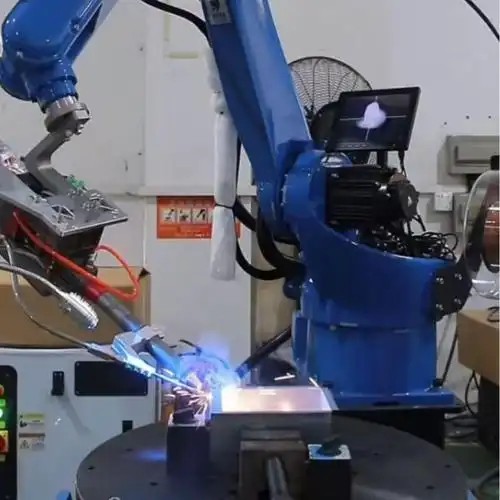
6 axis robot laser welding process
6-Axis Robot Movement Explained
The six axes of an industrial robot are coordinated to provide six degrees of freedom.
J1 – Base Rotation
The first axis rotates the robot around its base and changes the general working direction of the arm.
J2 – Shoulder Movement
The second axis moves the main arm section and controls a major part of the robot’s forward and backward reach.
J3 – Elbow Movement
The third axis changes the position of the forearm and extends the robot’s working envelope.
J4, J5 and J6 – Wrist Movement
The three wrist axes control the orientation of the welding head.Together, these axes allow the laser welding head to move and rotate through three-dimensional space
Robot Laser Welding vs CNC Laser Welding
Both CNC laser welding machines and robotic laser welding machines have their own suitable applications.
| Feature | CNC Laser Welding Machine | 6 Axis Robot Laser Welding Machine |
|---|---|---|
| Movement | XYZ / optional rotary axis | Six-axis articulated movement |
| Working area | Defined by machine platform | Defined by robot reach and cell layout |
| Welding direction | More limited by platform geometry | Highly flexible |
| Large workpieces | Limited by platform size | More suitable |
| Complex 3D parts | Possible with suitable configuration | Particularly suitable |
| Multi-angle welding | Requires suitable machine configuration | Natural advantage |
| Workpiece repositioning | May be required | Can often be reduced |
| Production automation | Available | Highly flexible for automation |
| Positioner integration | Optional | Commonly integrated |
| Best suited for | Fixed-size repetitive parts | Large, complex and varied parts |
The choice does not simply depend on which machine has more axes.
A CNC welding platform can be a practical choice when the workpieces are relatively small, flat, or consistently positioned.
A robotic system becomes more attractive when workpiece size, geometry, welding direction, and production flexibility become more demanding.
What Can a Robot Laser Welding Machine Weld?
The system can be configured for a wide range of metal welding applications, including:
Stainless Steel
Suitable for stainless steel housings, frames, enclosures, kitchen equipment, machinery components, and fabricated assemblies.
Carbon Steel
Used for machinery parts, structural components, brackets, frames, equipment housings, and industrial assemblies.
Aluminum
Laser welding can be used for aluminum components where suitable laser power, joint design, shielding gas, and process parameters are selected.
Galvanized Steel
Suitable for selected galvanized sheet and fabricated components, with welding parameters adjusted to the material and coating condition.
Copper and Copper Alloys
Copper has high reflectivity and thermal conductivity, so laser power and process configuration need to be selected according to the specific application.
Other Alloys
Titanium and other engineering alloys can also be considered after application testing and parameter development.The actual welding thickness and welding speed depend on material grade, thickness, joint design, gap, laser power, focus position, shielding gas, and other process conditions.
For demanding applications, ZS Machinery recommends sample welding before final machine configuration.
Typical Applications
The flexibility of a robotic arm makes this system suitable for workpieces that are too large, too complex, or too multi-directional for a simple fixed welding platform.
Machinery Components
- Machine frames
- Equipment housings
- Mechanical assemblies
- Brackets
- Structural components
Automotive Components
- Automotive metal components
- Exhaust components
- Chassis-related parts
- Structural assemblies
- Battery-related components
Tubular and Cylindrical Parts
- Pipes
- Tubes
- Cylindrical housings
- Flanges
- Pipe assemblies
- Round structural components
A rotary positioner can be added when the workpiece needs controlled rotation during welding.
Sheet Metal Assemblies
- Electrical cabinets
- Metal enclosures
- Stainless steel cabinets
- Equipment panels
- Fabricated sheet metal structures
Customized Metal Products
For manufacturers producing different workpieces rather than one standardized product, robotic welding provides greater programming and movement flexibility.
Robot + Rotary Positioner for More Flexible Welding
A six-axis robot does not have to work alone.For cylindrical or large three-dimensional components, a rotary positioner can be integrated with the robot.The robot controls the welding head while the positioner rotates or tilts the workpiece.This configuration can be used for applications such as:
- Pipe circumferential welding
- Pipe-to-flange welding
- Tube-to-end-cap welding
- Cylindrical housing welding
- Ring welding
- Large frame welding
The positioner can also help place the welding seam in a more accessible position, reducing unnecessary robot movement and manual repositioning.For large or heavy workpieces, the positioner is selected according to workpiece weight, dimensions, center of gravity, rotation speed, and welding requirements.
Vision and Seam Tracking Options
For highly repeatable parts and accurately positioned fixtures, a programmed robot path may be sufficient.For applications where the weld position can vary, a vision or seam-tracking system can provide additional flexibility.
Optional systems may include:
- CCD vision
- Laser positioning
- Laser seam tracking
- Weld seam detection
- Part recognition
The appropriate system depends on the actual variation between workpieces and the required welding accuracy.
How to Choose the Right Robot Laser Welding Machine
Robot selection should start with the workpiece, not the robot.Before selecting a configuration, ZS Machinery recommends evaluating:
1. Workpiece Size
Measure the maximum length, width, height, and welding position of the workpiece.This determines the required robot reach and cell layout.
2. Workpiece Weight
The robot payload must be sufficient for the welding head, cables, sensors, and other end-of-arm equipment.If a positioner is used, its payload must also match the workpiece.
3. Welding Position
Consider whether the welds are:
- Flat
- Vertical
- Horizontal
- Internal
- External
- Circumferential
- Multi-angle
- Three-dimensional
4. Material and Thickness
Material type and thickness determine the required laser power and welding process.
5. Production Volume
For high-volume production, additional automation such as dual-station worktables, automatic loading, vision inspection, and production-line integration may be worthwhile.
6. Need for Filler Wire
If the joint design requires additional material or gap bridging, an automatic wire feeder can be integrated.
Why Choose ZS Machinery?
Solid Machine Construction
ZS Machinery focuses on the mechanical structure and supporting equipment of the complete welding system, including the robot installation base, worktable, fixtures, positioner, electrical cabinet, and safety structure.
A stable mechanical foundation is important for maintaining repeatable robot movement and welding results during long-term operation.
Carefully Selected Components
Laser sources, welding heads, robot systems, controllers, servo components, cooling systems, and electrical components can be selected according to the customer’s application and budget.Rather than using the same configuration for every project, we focus on matching the machine to the actual welding requirements.
Experience in Laser Processing
ZS Machinery focuses on industrial laser applications including laser welding, cutting, and marking.
This experience allows us to look beyond the robot itself and consider the complete welding process—from workpiece positioning and laser parameters to wire feeding, fixtures, and automation.
Reliable After-Sales Support
We provide technical support for machine installation, operation, parameter setup, troubleshooting, and spare parts.
For customized robotic welding systems, we also work with customers to understand the workpiece and welding process before finalizing the machine configuration.
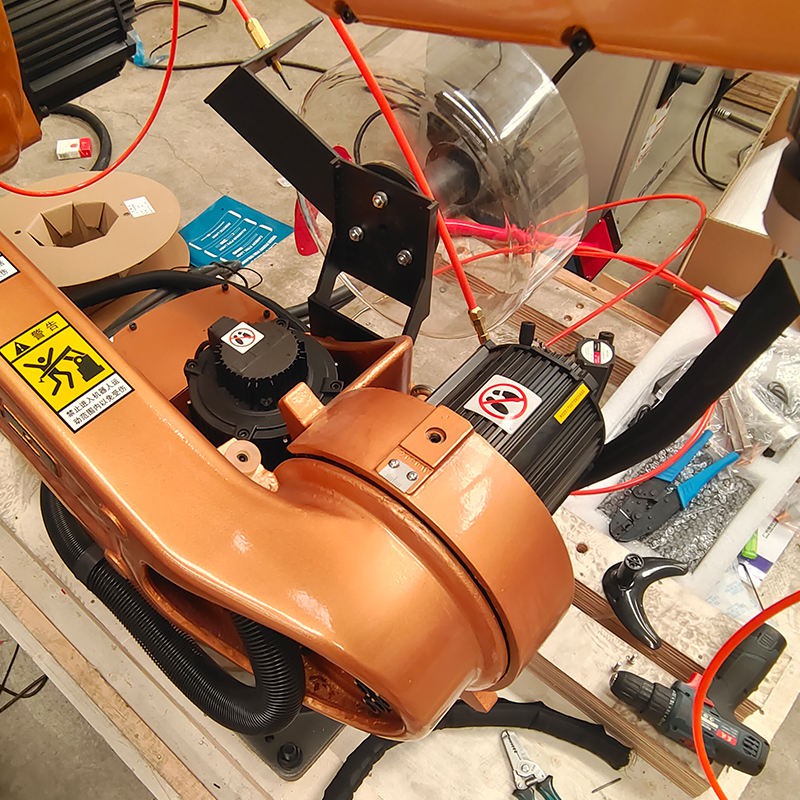
6 axis robot laser welding mahcine details
Send Your Workpiece for a Welding Test
A robotic laser welding machine should be configured according to the actual workpiece rather than selected only by laser power.Send us your:
- Workpiece photos
- Material
- Thickness
- Dimensions
- Welding joint drawings
- Required welding speed
- Production quantity
ZS Machinery can evaluate the application and recommend the appropriate robot reach, payload, laser power, welding head, positioner, fixture, and automation configuration.
Contact us now to get a Customized Robot Laser Welding Solution