
- Product Details
Automated Laser Cladding for Shaft Repair, Surface Restoration, and Wear Protection
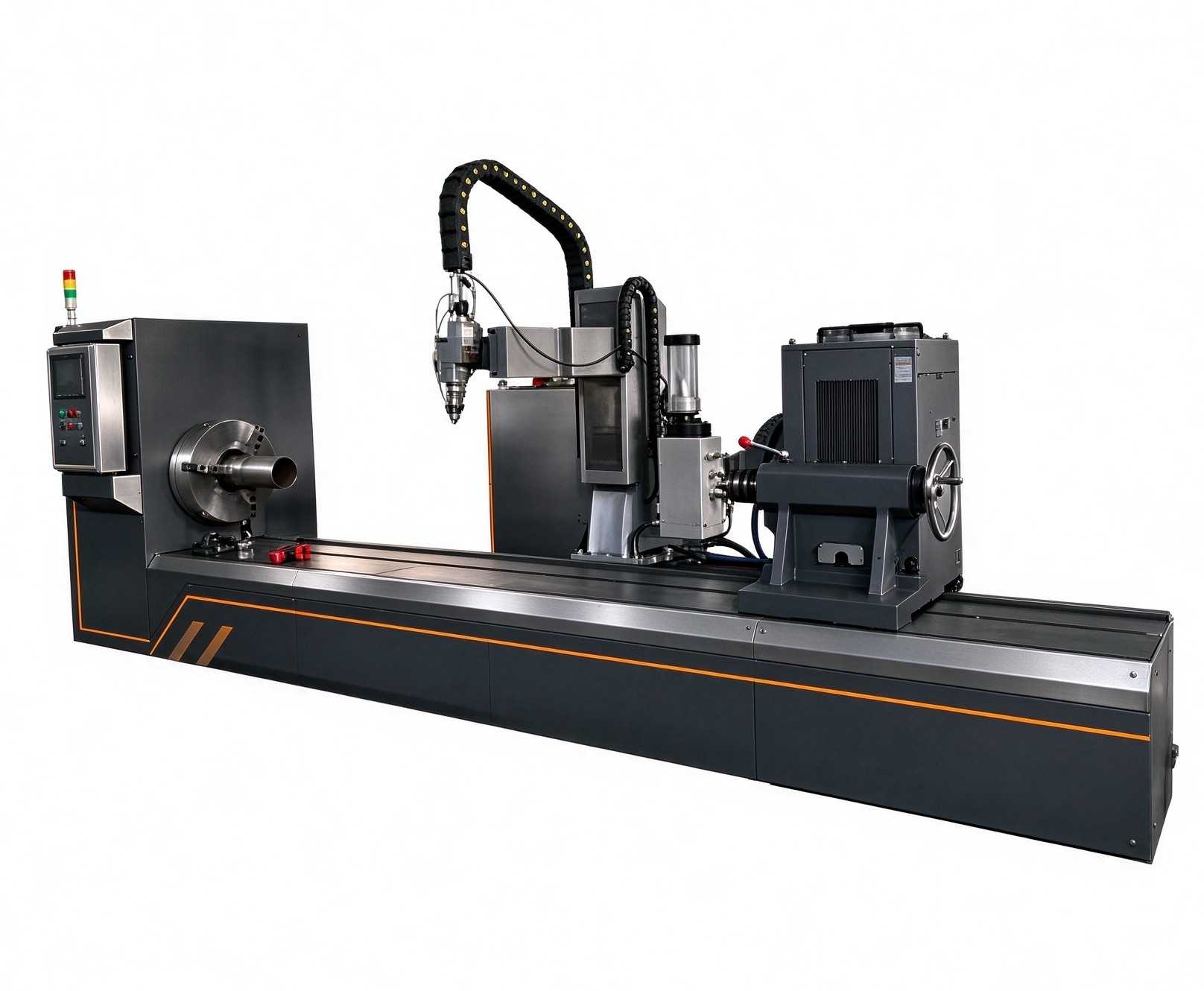
The 4 Axis Laser Cladding Machine is a CNC-controlled surface processing system designed for laser cladding on shafts, rollers, cylinders, and other metal components. By combining coordinated machine motion, a rotary workpiece axis, a laser cladding head, and a controlled material feeding system, it enables automated deposition of metallic coatings for component repair and surface enhancement.
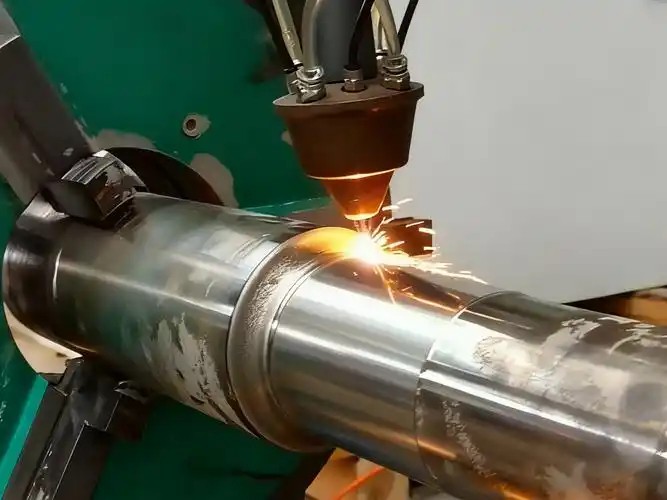
Laser cladding uses a focused laser beam to create a localized molten pool on the substrate while feeding metal powder or another compatible cladding material into the processing zone. The deposited material forms a metallurgical bond with the base metal, helping restore worn surfaces, rebuild component dimensions, or improve resistance to wear and corrosion.
With configurable clamping lengths, rotary diameters, laser sources, cladding heads, and powder feeding systems, this machine can be tailored to different workpiece geometries and production requirements. It is particularly suitable for manufacturers and maintenance facilities processing multiple types of shaft-like components in medium- and large-batch production.
4 axis laser cladding machine
What Is a 4 Axis Laser Cladding Machine?
A 4 Axis Laser Cladding Machine is a CNC-controlled laser processing system designed to deposit a layer of metallic material onto the surface of a metal workpiece. It uses a focused laser beam to create a localized molten pool while feeding metal powder into the processing area. The deposited material solidifies and forms a metallurgical bond with the base material, creating a functional coating or rebuilding a worn surface.
The four-axis configuration coordinates linear movement with workpiece rotation, allowing the laser cladding head to follow programmed paths along cylindrical and shaft-shaped components. This makes the machine particularly suitable for processing long shafts, rollers, cylinders, and other rotational parts that require surface restoration or wear-resistant coatings.
Unlike conventional laser welding, which primarily joins separate components or welds material together, laser cladding focuses on surface modification, dimensional restoration, and functional coating deposition. Depending on the selected cladding alloy and process parameters, it can help improve resistance to wear or corrosion and restore the dimensions of damaged components.
A typical 4 axis laser cladding system consists of a CNC motion platform, a rotary workpiece fixture, a laser source, a laser cladding head, a powder feeding system, and a cooling system. Optional monitoring and control functions can be integrated according to the application’s requirements.
The machine configuration should be selected according to workpiece dimensions, substrate material, cladding alloy, target coating properties, and production volume. For high-value industrial components, sample processing and quality testing are recommended to confirm the suitability of the process before production.
Key Features of the 4 Axis Laser Cladding Machine
1. Four-Axis CNC Motion for Rotational Components
The four-axis configuration coordinates the machine’s linear movements with workpiece rotation, allowing the cladding head to follow programmed paths along the component surface. This arrangement is suitable for processing cylindrical and shaft-shaped parts that require controlled circumferential or longitudinal cladding.
Depending on the machine configuration, the system can accommodate workpieces with clamping lengths from 1,000 to 20,000 mm and rotary diameters from 200 to 2,000 mm. These ranges are selectable configurations rather than a guarantee that every machine handles the maximum length and diameter simultaneously.
2. Laser Power Configurable Up to 15 kW
The machine supports fiber laser, semiconductor laser, and semiconductor-fiber-coupled laser configurations, with applicable laser power up to 15,000 W.
The appropriate laser source and power level depend on the substrate material, cladding alloy, target layer thickness, processing speed, and component geometry. A properly matched laser source and process window help achieve stable deposition and the required coating quality.
3. Multiple Laser Cladding Head Options
Different surfaces and coating requirements call for different beam profiles. The machine can be configured with several cladding head options:
- Reflective coaxial ring beam: Available spot configurations include 3 × 3 mm and 4 × 4 mm, producing a ring-shaped processing profile.
- Reflective coaxial wide beam: Options include 20 × 4 mm and 12 × 3 mm for wider cladding tracks.
- Reflective off-axis wide beam: Options include 20 × 4 mm and 25 × 4 mm for applications requiring an alternative beam and processing arrangement.
- Transmissive coaxial ring beam: Available with a 2–5 mm circular spot.
The most suitable head depends on the required cladding width, surface geometry, alloy material, deposition rate, and access to the processing area. Final selection should be confirmed through process testing.
4. Flexible Powder Feeding Configurations
The powder feeding system is available in single-barrel, double-barrel, and continuous powder feeding configurations.
A single-barrel feeder can suit standard production requirements. A double-barrel or continuous feeding arrangement can be considered when longer uninterrupted processing cycles are needed. The appropriate configuration depends on powder consumption, batch size, required operating continuity, and the selected cladding process.
5. CNC or PLC Control with Touchscreen Operation
The machine can be equipped with a CNC control system or a branded PLC control system with a 10-inch touchscreen. Operators can use the control interface to manage machine movements and programmed processing sequences.
Optional functions include CCD monitoring, closed-loop temperature control, and laser distance measurement. These features can help improve process observation, temperature regulation, and workpiece positioning when configured for the specific application.
6. Dual-Channel Water Cooling and Protective Components
The equipment uses a dual-channel, dual-temperature-control water cooling configuration to support the thermal management requirements of the laser and associated processing components.
Protective optics and suitable shielding gas are important for maintaining stable operation and protecting the optical path from contamination. Nitrogen and argon are available shielding gas options; the final choice depends on the cladding alloy and process requirements.
Laser Cladding Process
Applications of the 4 Axis Laser Cladding Machine
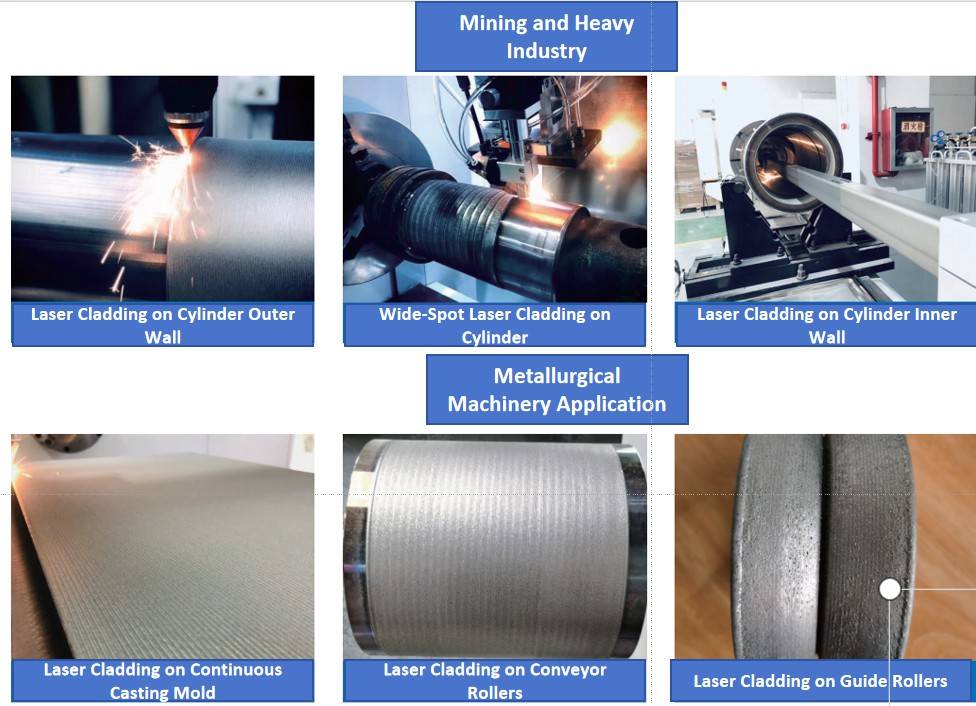
The machine is designed primarily for metal surface restoration, dimensional rebuilding, and functional coating deposition. Typical applications include the following.
Shaft and Transmission Component Repair
Shafts and transmission components can develop wear at bearing seats, journals, contact surfaces, and other high-load areas. Laser cladding can deposit compatible alloy material onto selected surfaces, allowing worn regions to be rebuilt before subsequent machining to the required dimensions.
Potential applications include:
- Drive shafts and transmission shafts
- Bearing journals and shaft seats
- Industrial rotating components
- Selected hydraulic and mechanical shafts
The repair process must account for the base material, original heat treatment, operating loads, and final dimensional tolerances.
Roller and Industrial Cylinder Cladding
Industrial rollers and cylindrical components may experience surface wear, abrasion, or corrosion during continuous operation. Laser cladding can apply a functional alloy layer to selected working surfaces, helping restore dimensions or improve surface performance.
Potential applications include:
- Industrial rollers and guide rollers
- Cylindrical metal components
- Selected hydraulic cylinder rods
- Rollers used in material handling and industrial production
The required alloy and coating properties should be selected according to the actual wear mechanism and working environment.
Wear- and Corrosion-Resistant Surface Coatings
In addition to component repair, laser cladding can be used to deposit compatible metallic alloys onto new or existing parts. Depending on the selected material system, the resulting layer may improve resistance to wear, corrosion, or other service-related damage.
The process is suitable for applications where a localized, metallurgically bonded coating is preferred over replacing the entire component. Coating performance must be validated for the intended operating conditions.
Remanufacturing of High-Value Components
For suitable components, laser cladding offers an alternative to replacing a worn part entirely. Material can be deposited onto selected areas, followed by machining or finishing where necessary.
This approach may help reduce material waste and extend component service life. Its economic value depends on the original component cost, repair area, required finishing, and the reliability of the restored part.
Laser Cladding Application
How the 4 Axis Laser Cladding Process Works
A typical production sequence includes the following steps:
Step 1: Inspect and Prepare the Workpiece
Inspect the component for wear, damage, contamination, and dimensional deviation. Remove oil, rust, or other contaminants and prepare the surface according to the selected process.
Step 2: Load and Position the Component
Secure the workpiece using the appropriate chuck, fixture, or supporting arrangement. Check alignment and rotation before processing.
Step 3: Select the Cladding Parameters
Choose the laser source, power, cladding head, powder feeding rate, shielding gas, rotation speed, and travel speed based on the substrate, alloy, and target coating.
Step 4: Program and Execute the Cladding Path
Set the required processing path and coordinate the linear movements with workpiece rotation. The CNC system controls the programmed motion sequence.
Step 5: Inspect the Clad Layer
After processing, inspect the coating for continuity, surface condition, bonding quality, and dimensional requirements. Depending on the application, metallographic examination, hardness testing, or other quality checks may be necessary.
Step 6: Perform Finishing Operations
Grinding, turning, or other finishing operations may be required to achieve the final dimensions and surface finish.
Laser Spot Configurations
| Cladding Head Type | Available Spot Size | Beam Profile |
|---|---|---|
| Reflective coaxial ring beam | 3 × 3 mm; 4 × 4 mm | Ring-shaped |
| Reflective coaxial wide beam | 20 × 4 mm; 12 × 3 mm | Wide beam |
| Reflective off-axis wide beam | 20 × 4 mm; 25 × 4 mm | Wide beam |
| Transmissive coaxial ring beam | 2–5 mm | Circular |
4 Axis Laser Cladding Machine vs. Conventional Repair Methods
The best repair process depends on the component, damage, material, and required service performance. Laser cladding is particularly worth evaluating when localized surface restoration or a functional alloy coating is required.
| Consideration | Laser Cladding | Conventional Repair or Coating |
|---|---|---|
| Material deposition | Localized laser-assisted deposition | Depends on the selected welding, coating, or repair process |
| Bonding mechanism | Metallurgical bonding with the substrate when properly processed | Varies by process |
| Heat input | Concentrated in the processing zone; actual thermal effects depend on parameters | Varies considerably by process |
| Automation | CNC-programmed motion and coordinated rotation | Ranges from manual to automated |
| Finishing | Machining or grinding may still be required | Depends on the repair method and tolerance |
| Best-fit applications | Selected high-value parts requiring localized restoration or functional coatings | Depends on component geometry, damage, material, and cost |
Laser cladding is not automatically the best choice for every worn component. Conventional welding, thermal spraying, electroplating, or component replacement may be more appropriate in some situations. A comparison based on service requirements and sample testing is recommended.
How to Choose the Right 4 Axis Laser Cladding Machine
Before selecting a configuration, consider these factors:
Workpiece dimensions: Confirm the component’s total length, cladding length, maximum diameter, weight, and loading requirements.
Base material and cladding alloy: Identify the substrate and proposed powder material. Their compatibility affects bonding, cracking risk, dilution, and final coating properties.
Cladding area and required layer: Define the repair location, target dimensions, required coating thickness, and whether multiple deposition passes are necessary.
Production requirements: Evaluate batch size, processing time, powder consumption, and whether single-barrel, double-barrel, or continuous powder feeding is appropriate.
Process monitoring: Determine whether CCD monitoring, closed-loop temperature control, or laser distance measurement is needed for your application.
Finishing and quality control: Establish the final dimensional tolerances, surface finish, hardness, bonding, and inspection requirements before choosing the process.
For demanding applications, sample processing is recommended to verify the coating quality and establish suitable parameters before equipment acceptance.
Why Work with ZS Machinery?
ZS Machinery helps industrial customers evaluate laser processing equipment according to their workpieces, production requirements, and automation goals. We coordinate suitable equipment configurations and technical support with manufacturing and engineering resources.
Our approach focuses on:
- Application-based configuration: Matching the machine layout, cladding head, laser power, and powder feeding system to the actual job.
- Technical coordination: Clarifying workpiece dimensions, materials, repair requirements, and process parameters before finalizing a solution.
- Practical equipment selection: Considering the full process, including loading, cladding, inspection, and finishing.
- Project support: Helping customers evaluate configurations and coordinate technical communication during equipment selection.
Request a 4 Axis Laser Cladding Solution
Looking for a laser cladding machine for shaft repair, roller refurbishment, dimensional restoration, or wear-resistant coating?
Send us your workpiece drawings or photos, material information, dimensions, damaged area, target coating requirements, and expected production volume. Our team can help evaluate a suitable machine configuration, laser power, cladding head, and powder feeding arrangement for your application.
Contact ZS Machinery to discuss your 4 Axis Laser Cladding Machine requirements and request a customized proposal.