
CNC Laser Welding In Kitchenware Industry
CNC laser welding in the kitchenware industry is increasingly suitable for stainless steel products that require clean welds, consistent quality, good corrosion resistance, and controlled heat input. Stainless steel is widely used in kitchenware and food equipment because it is durable, easy to clean, and suitable for many food-related applications. Among the commonly used grades, 304 and 316 stainless steel are particularly important for cookware, kettles, food containers, beverage equipment, commercial kitchen products, and food-processing equipment.
Many kitchenware products also have round, curved, or multi-angle structures, making the welding process more complicated than simply welding a straight seam. A stainless steel kettle, for example, may require welding around a circular body as well as at the spout, handle, bottom, or other connections. For these applications, CNC laser welding can provide programmed and repeatable welding movement, while a rotary fixture can rotate the workpiece during welding.
For this reason, a 5 Axis CNC Laser Welding Machine is a practical solution for many kitchenware applications. The rotary axis rotates the workpiece, while the welding-head swing axis changes the welding angle, allowing the same system to handle different welding positions and product geometries. For suitable joints, laser welding can also be performed without filler wire; when additional material is required, a compatible stainless steel welding wire can be used.
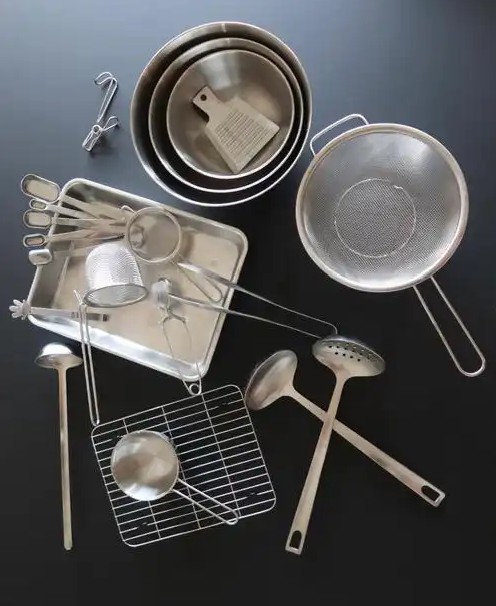
Stainless steel kitchenware need to weld
Characteristics of the Kitchenware & Food Equipment Industry
Kitchenware and food equipment are different from many general metal fabrication products.
The finished product may come into direct or indirect contact with food, beverages, water, steam, or cleaning agents. Therefore, the manufacturer is usually concerned not only with weld strength, but also with corrosion resistance, surface quality, cleanliness, and ease of cleaning.
1.Stainless Steel Is the Main Material
304 stainless steel is widely used for general kitchenware and food equipment, while 316 stainless steel is often selected when higher corrosion resistance is required.Typical products include:
- Stainless steel kettles
- Pots and cookware
- Food containers
- Beverage containers
- Food-processing vessels
- Commercial kitchen equipment
- Stainless steel sinks
- Brewing equipment
- Food preparation equipment
Both 304 and 316 stainless steel are highly suitable for laser welding when the material condition, joint design, and welding parameters are properly matched.
2.Clean and Controlled Welds Matter
Kitchen and food equipment often require welds that can be cleaned easily and finished smoothly.For suitable joints, laser welding can be performed without filler wire. The laser melts the edges of the stainless steel components and forms the joint using the base material itself.
When filler is required, a suitable stainless steel welding wire can be used.
This gives the manufacturer greater control over the material entering the weld. Instead of using a coated electrode that introduces electrode coating and other welding materials into the process, the manufacturer can use a compatible stainless steel filler when additional material is necessary.
This is particularly useful when material consistency, weld cleanliness, surface finishing, and corrosion resistance are important considerations.
3.Many Products Have Curved or Circular Welds
Kitchenware is not limited to flat sheet-metal welding.Many products have:
- Circular bodies
- Round bottoms
- Curved surfaces
- Circular openings
- Handles
- Spouts
- Rims
- Angled connections
- Multiple welding directions
A stainless steel kettle, for example, may require welding at several different positions around a curved body.This makes multi-axis welding particularly useful for this industry.
CNC Laser Welding Applications in Kitchenware & Food Equipment
The application range is much broader than simple stainless steel sheet welding.
Stainless Steel Kettles
Stainless steel kettles are one of the typical applications for CNC laser welding.Depending on the product design, a kettle may require welding for:
- Kettle body
- Bottom
- Spout
- Handle
- Lid components
- Circular openings
- Connecting parts
The kettle body is usually a curved or circular component, so a rotary fixture can rotate the workpiece during welding.However, the welding positions are not always identical. The welding head may need to approach different joints from different directions.
Stainless Steel Pots and Cookware
CNC Laser welding can be used for selected stainless steel cookware products, including:
- Cooking pots
- Sauce pans
- Stock pots
- Deep cooking vessels
- Stainless steel bowls
- Commercial cookware
Depending on the design, welding may be required around the bottom, rim, handle connection, or other assembled components.For products with multiple curved or angled joints, the additional movement of a 5-axis system can help maintain a suitable welding position throughout the process.
Stainless Steel Food Containers
Food containers are another important application.Examples include:
- Stainless steel food storage containers
- Food trays
- Ingredient containers
- Catering containers
- Commercial food bins
- Stainless steel storage vessels
Laser welding can be used for selected seams, corners, bottoms, covers, and connection points.For products with circular or curved structures, the rotary fixture can simplify the welding path and improve production consistency.
Stainless Steel Beverage Containers
Stainless steel is widely used in beverage-related products.Potential applications include:
- Beverage bottles
- Stainless steel cups
- Beverage containers
- Insulated container components
- Bottle openings
- Container bottoms
- Circular seams
Many of these products contain rotational geometries, making a rotary fixture useful.
For products requiring different welding orientations, a 5-axis machine provides additional flexibility beyond simply rotating the workpiece.
Stainless Steel Sinks
Stainless steel sinks are commonly manufactured from formed stainless steel sheet.Laser welding can be considered for selected:
- Sink bowl joints
- Corner seams
- Drain components
- Reinforcement components
- Mounting parts
Because sink structures contain formed surfaces and corners, the welding head may need to change orientation during the welding process.A multi-axis system can therefore provide more flexibility for customized sink designs.
Sometimes, grooves need to be cut into water sinks, and in these cases, a custom-made laser cutting machine with a multi-axis system is also very suitable.
Stainless Steel Food Processing Vessels
Food-processing equipment often uses stainless steel vessels for mixing, heating, storing, and transferring food products.Examples include:
- Mixing vessels
- Preparation tanks
- Small processing tanks
- Ingredient vessels
- Stainless steel containers
- Processing chambers
Circular vessels can be mounted on a rotary fixture for continuous circumferential welding.For vessels containing different connection points, openings, or angled components, the welding-head swing axis can provide additional access.
Stainless Steel Beverage and Brewing Equipment
Brewing and beverage equipment commonly uses 304 or 316 stainless steel.Laser welding can be considered for products such as:
- Brewing vessels
- Beverage tanks
- Fermentation equipment
- Liquid containers
- Stainless steel fittings
- Small beverage-processing assemblies
Circular tanks and vessels can use rotary welding, while more complicated components may require different welding-head orientations.
Stainless Steel Food Preparation Equipment
Commercial food preparation equipment often contains welded stainless steel assemblies.Examples include:
- Food preparation tables
- Stainless steel working stations
- Food preparation vessels
- Stainless steel containers
- Equipment covers
- Food-contact components
Laser welding can provide controlled and repeatable welding for suitable stainless steel assemblies where appearance and surface quality are important.
Stainless Steel Commercial Kitchen Equipment
Commercial kitchens use stainless steel in many products beyond cookware.Potential applications include:
- Commercial cooking equipment
- Stainless steel equipment panels
- Kitchen workstations
- Equipment covers
- Stainless steel cabinets
- Food preparation equipment
- Custom kitchen equipment
The actual welding process depends on the product structure, sheet thickness, joint design, and required surface finish.
Stainless Steel Food-Contact Components
Some food equipment contains small stainless steel components that directly contact food or beverages.These may include:
- Food-contact vessels
- Liquid channels
- Stainless steel containers
- Small processing components
- Internal stainless steel assemblies
For these products, welding quality and surface condition can be particularly important.
The welding process should be developed to minimize defects and produce a joint that can be properly cleaned and finished.
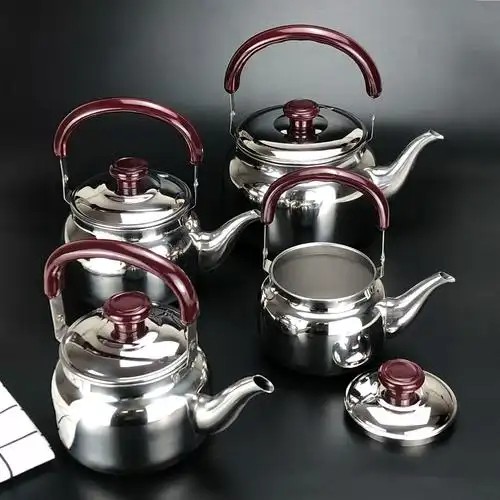
Stainless steel kettle
Recommended Equipment: 5 Axis CNC Laser Welding Machine
For many kitchenware and food equipment applications, ZS Machinery recommends a 5 Axis CNC Laser Welding Machine as a versatile configuration.
The machine combines:
X + Y + Z + Rotary Axis + Welding Head Swing Axis
The two additional movements perform different functions.
Rotary Axis for Round Products
The rotary axis rotates the workpiece around its center.This is useful for:
- Kettles
- Pots
- Cylindrical containers
- Beverage containers
- Round vessels
- Circular components
- Stainless steel tanks
Instead of manually moving the welding torch around a circular product, the workpiece can be rotated according to the programmed welding path.
Welding Head Swing Axis for Different Welding Angles
The fifth axis changes the orientation of the welding head.This is important because kitchenware products often contain different welding surfaces.
For example, a stainless steel kettle may have a circular body seam, a spout connection, a handle connection, and other joints. These welds may not all require the same welding-head angle.The swing axis allows the welding head to change its orientation during the programmed process.
Why 5 Axis Is Suitable for Kitchenware
The main advantage is versatility.
A 4-axis system can rotate a round workpiece, but the welding head remains relatively limited in its orientation.While a 5-axis system combines workpiece rotation with welding-head movement.This makes it suitable for a broader range of kitchenware products without requiring a completely different machine structure for every product.For manufacturers producing multiple stainless steel products, this flexibility can be especially valuable.
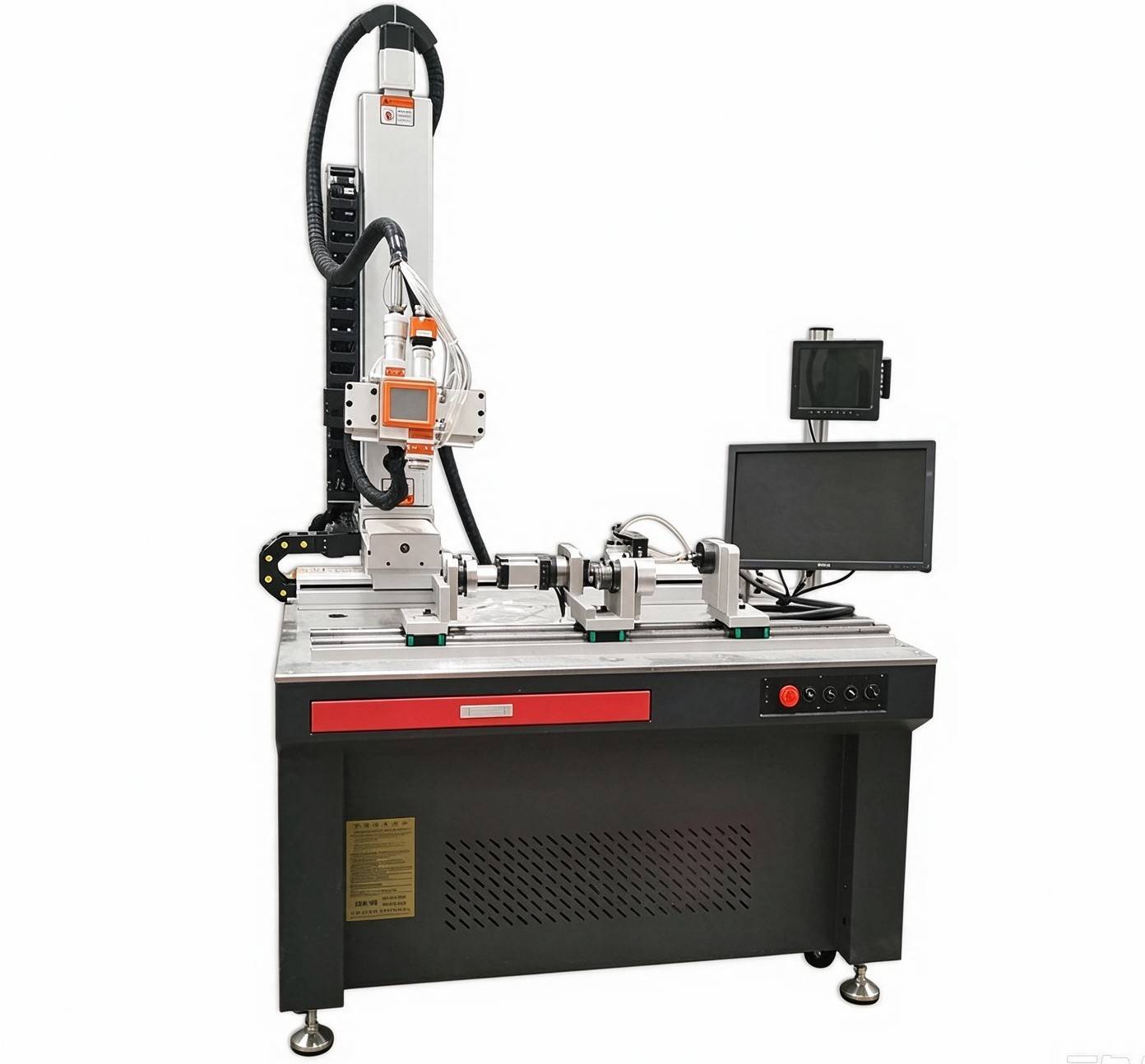
5 axis cnc laser welding machine
Stainless Steel Laser Welding With or Without Filler Wire
One of the useful characteristics of laser welding is that suitable stainless steel joints can often be welded without additional filler material.
Autogenous Welding
When the two stainless steel components have an appropriate joint fit, the laser can melt the edges of the components directly and form the weld.No filler wire is required.This can be useful for:
- Closely fitted stainless steel sheets
- Thin stainless steel components
- Circular seams
- Butt joints
- Precision stainless steel assemblies
The resulting weld is formed primarily from the original 304 or 316 stainless steel.
Stainless Steel Filler Wire
Not every joint can or should be welded without filler.Wire feeding may be used when the application requires:
- Additional weld reinforcement
- Larger joint gaps
- More material in the joint
- Special joint geometry
- Additional process tolerance
When wire is required, the filler can be selected as a compatible stainless steel welding wire according to the base material and application.For food equipment, this provides a controlled approach to the material introduced into the welded joint.
Why Choose Laser Welding for Stainless Steel Kitchenware?
Laser welding is not simply about making the welding process faster.For kitchenware and food equipment, several characteristics are particularly relevant.
Controlled Heat Input
The laser concentrates energy in a small area.This can help reduce unnecessary heating of surrounding stainless steel and, for suitable products, reduce thermal deformation.
Clean Welding Process
Suitable joints can be welded without filler wire.When filler is required, a compatible stainless steel wire can be selected.This provides control over the material used to form the weld.
Suitable for 304 and 316 Stainless Steel
Both 304 and 316 stainless steel are widely used in this industry and can be laser welded effectively when the correct parameters are developed.
Good for Circular Products
With a rotary fixture, circular and cylindrical products can be welded continuously.This makes the process suitable for kettles, pots, vessels, containers, and other round products.
Repeatable Production
Once the welding path and process parameters have been developed, CNC control can repeat the same movement for each workpiece.This can reduce variation caused by manual torch movement in high-volume production.
Suitable for Automation
A CNC laser welding machine can be integrated with:
- Customized fixtures
- Rotary fixtures
- Automatic loading and unloading
- Wire feeders
- Vision systems
- Production-line automation
This allows manufacturers to develop a welding process around the actual product rather than simply replacing a manual welding torch.
Customized Fixtures for Kitchenware Laser Welding
The fixture is an important part of the welding system.For kitchenware, different products often have different shapes, so a standard fixture may not be sufficient.For example, a kettle welding system may require a customized fixture to:
- Hold the kettle body
- Maintain the correct joint position
- Rotate the product
- Support the product during welding
- Maintain consistent alignment
The fixture can be designed together with the 5-axis CNC laser welding machine.For manufacturers producing several product models, interchangeable fixtures can also be considered depending on the production requirements.
From Sample Welding to Production
For a new kitchenware product, the recommended process is to test the actual workpiece before finalizing the machine configuration.The process can include:
Product → Sample Welding → Parameter Development → Fixture Design → Machine Configuration → Production
The test should evaluate:
- Material grade
- Material thickness
- Joint design
- Welding speed
- Laser power
- Welding-head position
- Shielding gas
- Filler wire requirement
- Weld appearance
- Penetration
- Deformation
- Surface finishing requirements
This is particularly important for stainless steel products with visible welds or food-contact surfaces.
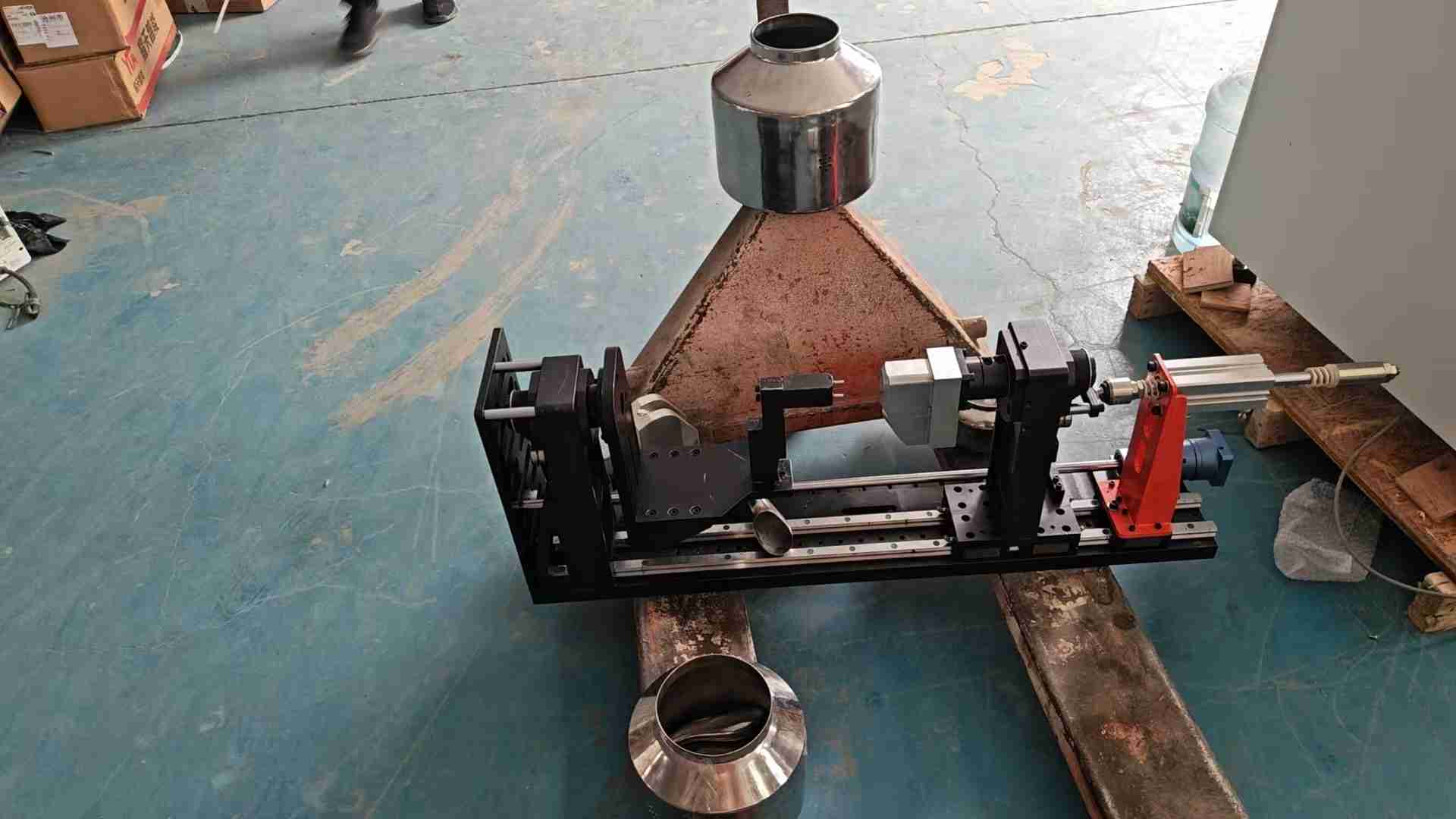
Stainless steel kettle welding custom fixture
Why Choose ZS Machinery?
ZS Machinery provides CNC laser welding solutions for stainless steel kitchenware and food equipment, with a focus on matching the machine configuration to the actual product.
For round and curved stainless steel products, our 5 Axis CNC Laser Welding Machine with customized rotary fixture can provide both workpiece rotation and welding-head angle control.
Typical applications include:
- Stainless steel kettles
- Pots and cookware
- Food containers
- Beverage containers
- Food-processing vessels
- Brewing equipment
- Stainless steel sinks
- Commercial kitchen equipment
- Food preparation equipment
- Custom stainless steel food equipment
For applications using 304 or 316 stainless steel, we can evaluate the product structure and recommend whether autogenous laser welding or stainless steel wire feeding is more appropriate.Sample testing can also be performed to evaluate the welding process before production.
Conclusion
CNC laser welding is a suitable solution for many stainless steel kitchenware and food equipment applications. 304 and 316 stainless steel, combined with a 5-axis CNC system, can meet the welding requirements of many round, curved, and multi-angle products.
Contact ZS Machinery
Have a stainless steel kitchenware or food equipment project? Contact ZS Machinery to discuss your product and find a suitable 5 Axis CNC Laser Welding Machine.