
CNC Laser Welding in Electronics & Electrical Industry
CNC laser welding in electronics and electrical industry is increasingly used for precision joining of electronic housings, connectors, terminals, copper components, sensors, busbars, heat sinks, power electronics enclosures, and other metal assemblies.
Unlike conventional welding applications that often focus mainly on penetration and structural strength, electronic and electrical components can require much tighter control of heat input, weld size, positioning accuracy, distortion, and electrical performance. Small components may contain sensitive internal parts that can be affected by excessive heat, while electrical connections may require reliable low-resistance joints.
Laser welding is well suited to these requirements because the laser beam can deliver concentrated energy to a precisely controlled area. The process is non-contact and can be integrated with CNC motion systems, galvanometer scanners, vision systems, fixtures, and automated production equipment.
ZS Machinery uses laser and resistance welding technologies for electronic packages, sensors, terminals, connectors, semiconductor packages, and other precision electronic components.And CNC and automated laser welding an important manufacturing option for both precision electronics and larger electrical equipment.
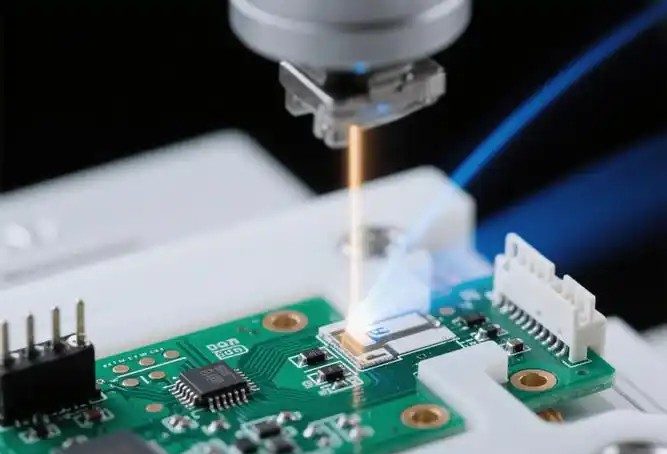
Laser welding of electronic products
Why Laser Welding Is Suitable for Electronics and Electrical Components
Electronics manufacturing places different demands on welding compared with many conventional metal fabrication applications.A component may be only a few millimeters in size, but the weld still needs to provide reliable mechanical and electrical performance. At the same time, nearby electronic components, insulation, coatings, or sensitive materials may have limited tolerance to heat.Laser welding addresses several of these requirements.
1.Precise Energy Delivery
A focused laser beam can concentrate energy into a small welding area. This makes it possible to create localized welds without heating the entire component.For miniature electronic components, this can help reduce unnecessary thermal exposure. For larger electrical components such as busbars and housings, controlled energy delivery can help maintain dimensional accuracy and reduce distortion.
2.Low Heat Input
Electronic assemblies often contain temperature-sensitive components, coatings, seals, plastics, or other materials close to the weld.A controlled laser process can limit the heat affected area compared with some conventional joining methods. This is particularly valuable for electronic packages, sensors, terminals, and miniature assemblies.
3.Non-Contact Welding
Laser welding does not require a welding electrode to physically contact the joint.This is useful for small or difficult-to-access components where mechanical electrodes may interfere with the part or limit the available welding geometry.
The workpiece is instead positioned and clamped by a fixture while the laser is directed onto the joint. For electronic package sealing, for example, laser welding can be used to create seams around the package after the lid and housing have been accurately positioned.
4.High Repeatability
Electronic and electrical products are often manufactured in large quantities. Once a suitable welding process has been developed, CNC motion, programmable laser parameters, fixtures, and monitoring systems can help reproduce the same weld pattern from part to part.This is particularly important for:
- Electrical connectors
- Sensor housings
- Terminal assemblies
- Electronic packages
- Copper busbars
- Power electronics housings
- Switchgear components
What Electronics and Electrical Components Can Laser Weld?
1.Electronic Enclosures
Electronic enclosures protect internal circuit boards, sensors, controllers, communication modules, and other components.Laser welding can join enclosure covers, housings, frames, and other metal sections where a clean and controlled joint is required.Applications include:
- Electronic control housings
- Instrument housings
- Controller enclosures
- Sensor enclosures
- Communication equipment housings
- Industrial electronic housings
- Small metal device enclosures
- Power Supply Housings
These products can achieve excellent welding results using CNC laser welding.
2.Electrical Connectors
Electrical connectors require reliable mechanical attachment and electrical conductivity.Laser welding can be used for connector terminals, metal contacts, connector housings, and wire-to-terminal or terminal-to-conductor assemblies, depending on the design.The process is particularly interesting when the joint is small, production volume is high, and consistent weld positioning is required.
3.Copper Busbars
Copper busbars are one of the more technically demanding laser welding applications in electrical manufacturing.Copper has high thermal conductivity and reflects infrared laser energy strongly, making process development more demanding than welding many common steels.
However, laser welding can provide concentrated energy and high process control for copper connections when the laser source, wavelength, beam characteristics, joint design, and parameters are properly selected.Busbar applications can include:
- Copper busbars
- Laminated busbars
- Busbar terminals
- Power distribution components
- Electrical connection plates
- Power electronics connections
- Battery-related electrical connections
4.Terminal Blocks
Terminal blocks connect and organize electrical conductors inside control systems, industrial equipment, power distribution systems, and electrical cabinets.CNC Laser welding may be used for metal terminal components and internal electrical connections where controlled, repeatable joining is required.The exact process depends on terminal geometry, conductor material, coating, required electrical performance, and production volume.
5.Switchgear Components
Switchgear contains components used to control, protect, and isolate electrical circuits.
Laser welding can be applied to selected metal components, housings, connectors, terminals, and conductive assemblies where accurate and repeatable joining is required.
Large electrical assemblies may require a different system configuration from miniature electronic components. For example, larger housings can use CNC positioning tables or robotic systems, while small terminals may require a precision laser welding platform.
6.Circuit Breaker Components
Circuit breakers contain multiple mechanical and electrical components that must work reliably over repeated operating cycles.Depending on the component design, laser welding may be used for metal housings, terminals, conductive parts, contact-related assemblies, or other small components.
The welding process must be developed around the specific material, geometry, coating, electrical requirements, and acceptable thermal exposure.
7.EMI Shielding Components
Electromagnetic interference can affect the performance of sensitive electronic systems.Metal shielding components and enclosures can therefore require controlled joining to maintain their designed shielding structure.
Laser welding can be used for selected shielding housings, covers, frames, and other metal components where localized and repeatable joining is required.
8.Heat Sinks
Heat sinks are used to transfer heat away from electronic and power components.Depending on the product design, laser welding can be used to join heat-sink components or attach specific metal structures.
Aluminum and copper are common materials in thermal-management applications, but their thermal conductivity and optical properties make process development important.
9.Electrical Cabinets
Electrical cabinets are much larger than typical electronic components, but laser welding can still be useful for cabinet frames, panels, brackets, doors, and other sheet-metal components.This is where the Electronics & Electrical category overlaps with sheet-metal fabrication.
The welding system does not necessarily need to be a micro-welding system. Depending on cabinet size and production requirements, manufacturers may use CNC laser welding machines, automated platforms, or robotic laser welding cells.

Welding In Electronic Industry
CNC Laser Welding Systems for Electronics and Electrical Manufacturing
There is no single CNC laser welding machine suitable for every electronic or electrical application.The appropriate system depends strongly on the size of the component and the precision required.
Precision CNC Laser Welding Machine
A precision CNC system can control the welding head along programmed X, Y, and Z movements.It can be used for:
- Electronic housings
- Connector components
- Sensor housings
- Terminal assemblies
- Small electrical components
- Repetitive welding patterns
Galvanometer Laser Welding System
For small parts and fast welding paths, a galvanometer scanning system can move the laser beam rapidly across the workpiece.This can be useful for compact components and high-speed production where the welding area is relatively small.
Professional laser welding systems for electronics can combine fixed optics or galvo scanning with monitoring and optional vision systems depending on the application.
Rotary-Axis Laser Welding Machine
A rotary axis can be useful when the component has a cylindrical or rotational geometry.Examples include:
- Sensor housings
- Cylindrical electronic housings
- Tubular connectors
- Round terminals
- Circular sealing joints
The rotary axis changes the orientation of the workpiece while the laser follows the programmed welding path.
Automated Laser Welding Cell
For high-volume manufacturing, the welding system can be integrated with:
- Automatic loading
- Precision fixtures
- CNC motion
- Laser source
- Vision alignment
- Weld monitoring
- Rotary positioning
- Unloading systems
- Production data collection
This allows laser welding to become part of a larger automated manufacturing line rather than operating as an isolated machine.
Vision and Process Monitoring
Precision welding requires more than a laser source.Small electronic components may require accurate positioning before the welding process begins. Vision systems can help identify component position, alignment, orientation, or reference features.Process monitoring can also be used to observe welding conditions and identify abnormal process behavior.Typical system options include:
- CCD or industrial camera
- Vision alignment
- Weld monitoring
- Laser power monitoring
- Temperature monitoring
- Position sensors
- Automatic parameter control
- Production data recording
The exact level of monitoring should be matched to the product’s quality requirements and production volume.
Materials Commonly Considered for Electronics and Electrical Laser Welding
Materials vary significantly across this industry.Common materials include:
- Copper
- Aluminum
- Stainless steel
- Mild steel
- Nickel
- Kovar and similar electronic-package alloys
- Brass
- Titanium in specialized applications
- Nickel-plated metals
- Other coated or dissimilar-metal combinations
The material alone does not determine whether laser welding will work.
Surface condition, plating, thickness, joint configuration, component design, laser wavelength, beam quality, shielding gas, clamping, and welding parameters can all affect the result.This is particularly important for copper and dissimilar-metal applications.
How to Choose a CNC Laser Welding Machine for Electronics
The most important step is to start with the component rather than the laser power.
1. Identify the Material
Determine whether the component is made from copper, aluminum, stainless steel, steel, nickel, Kovar, brass, or a material combination.
2. Measure the Joint
The required laser configuration depends on:
- Material thickness
- Joint width
- Weld depth
- Weld length
- Joint type
- Required penetration
3. Define the Production Requirement
A laboratory prototype may only require a compact manual or semi-automatic system.High-volume production may require:
- Automatic loading
- Vision
- CNC motion
- Galvo scanning
- Rotary positioning
- Process monitoring
- Inline inspection
4. Consider Thermal Sensitivity
If sensitive electronic components are located close to the weld, thermal exposure becomes an important process parameter.
5. Consider Electrical Performance
For conductive joints, the final weld must satisfy the required mechanical and electrical characteristics.
6. Test the Actual Component
Laser welding performance cannot be determined reliably from material names and thickness alone.For demanding electronic and electrical applications, sample welding should be performed using the actual component, joint design, surface condition, and production requirements.
The Future of Laser Welding in Electronics and Electrical Manufacturing
As electronic and electrical products continue to become smaller, more powerful, and more highly integrated, manufacturing processes will need greater control over heat, positioning, and process consistency.Laser welding systems are likely to become increasingly integrated with vision, automation, monitoring, and production data systems.
For miniature electronic components, the development of more specialized laser sources and beam-delivery technologies can expand the range of conductive and dissimilar-metal applications. For larger electrical components, automated CNC and robotic systems can provide higher productivity and repeatability.
The result is a broader spectrum of laser welding systems, from precision micro-welding platforms for electronic packages and connectors to automated welding cells for busbars, power electronics, electrical housings, and larger industrial equipment.
Conclusion
CNC laser welding in the electronics and electrical industry covers a wide range of applications, from miniature electronic packages and connectors to copper busbars, power electronics housings, heat sinks, switchgear components, and electrical cabinets.
The main advantages are not simply welding speed. For many electronic applications, the more important factors are precision, controlled heat input, non-contact processing, repeatability, low distortion, and the ability to integrate vision and automation.
ZS Machinery provides CNC and automated laser welding solutions for electronic and electrical manufacturing, with configurations that can be adapted to different materials, component sizes, joint designs, production volumes, and automation requirements. For demanding applications such as electronic enclosures, copper busbars, electrical connectors, sensor housings, and sealed electronic packages, sample testing can be used to determine the appropriate laser source, welding head, motion system, fixture, and process parameters.