
CNC Laser Welding Stainless Steel
Stainless steel is one of the most widely used materials for cnc laser welding. It combines good corrosion resistance, high strength, attractive surface quality, and relatively good weldability, making it suitable for applications ranging from sheet metal fabrication and kitchen equipment to tubes, pipe fittings, cabinets, medical components, industrial equipment, and automotive parts.
Compared with conventional welding processes,cnc laser welding can produce a narrow weld seam and a relatively small heat-affected area. This can help reduce thermal distortion and minimize post-welding finishing when the joint design and process parameters are suitable.
ZS Machinery has participated in stainless steel welding projects involving tubes, pipe fittings, kitchen equipment, sheet metal parts, electrical cabinets, mesh cylinders, industrial equipment, and other fabricated components. Based on the actual product, we can configure 3-axis CNC, rotary-axis, multi-axis, robotic, or customized laser welding systems.
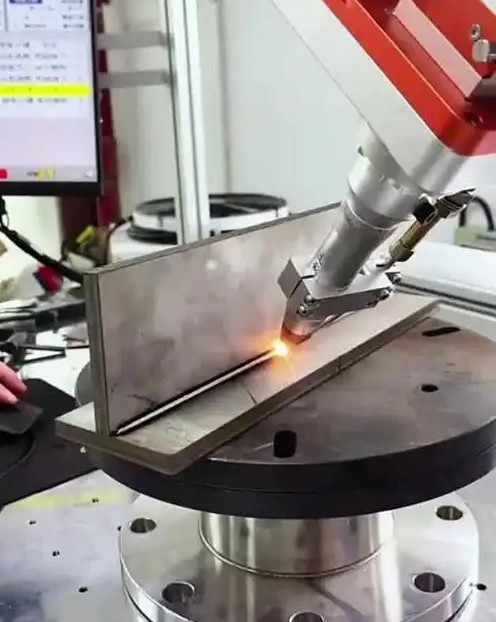
CNC laser welding stainless steel sheet
Why Is Stainless Steel Suitable for Laser Welding?
Stainless steel is generally considered a relatively easy material for laser welding compared with more demanding materials such as copper or some aluminum alloys.One reason is that common stainless steel grades used in manufacturing have well-established welding processes and relatively predictable behavior under controlled laser heating.
Compared to the high reflectivity of aluminum and copper, stainless steel exhibits better laser absorption. Carbon steel, especially medium and high carbon steel, is prone to cracking during welding. Stainless steel, however, generally has strictly controlled carbon content, which means that laser welding of stainless steel requires only simple process adjustments and virtually eliminates cracking issues.
In addition, stainless steel products often have high requirements for hygiene and weld quality, such as in the food industry. Traditional welding rods sometimes contain harmful substances, making them unsuitable for such applications. Laser welding, whether autogenous welding or wire-fed welding, does not introduce additional substances, thus making it more hygienic and safer.
Which Stainless Steel Grades Can Be Laser Welded?
Almost all commonly used stainless steel families can be considered for laser welding when the material grade, joint design, and welding process are properly matched. Stainless steel is generally a highly suitable material for laser welding, and the technology is widely used across sheet metal fabrication, tubes and pipes, kitchen equipment, medical devices, industrial equipment, automotive components, and other applications.
1.Austenitic Stainless Steel
Austenitic stainless steels are the most widely used stainless steel family and include many of the grades commonly encountered in industrial laser welding.Typical characteristics include good corrosion resistance, good formability, and generally good weldability.Common grades include:
- 304
- 304L
- 316
- 316L
- 321
- 347
304 and 304L are widely used in general stainless steel fabrication, kitchen equipment, food-processing equipment, cabinets, tubes, tanks, furniture, and industrial components.
316 and 316L are commonly selected for applications requiring higher corrosion resistance, including medical equipment, chemical equipment, pharmaceutical equipment, food-processing systems, marine-related applications, and stainless steel piping.
Other grades such as 321 and 347 are used in applications where their specific alloy characteristics provide advantages, including elevated-temperature or specialized industrial applications.For many general-purpose CNC laser welding applications, austenitic stainless steel is one of the most established material groups.
2.Ferritic Stainless Steel
Ferritic stainless steels contain chromium as a major alloying element and have a different metallurgical structure from austenitic stainless steels.Common examples include:
- 409
- 430
- 439
- 441
430 stainless steel is particularly common in appliances, kitchen equipment, decorative components, automotive applications, and sheet metal products.Ferritic stainless steels can be laser welded, but the welding process should be developed according to the specific grade, thickness, joint design, and required mechanical properties.
3.Martensitic Stainless Steel
Martensitic stainless steels are generally associated with higher hardness and strength and are used in applications where these properties are important.Common grades include:
- 410
- 420
- 440C
Typical applications include:
- Shafts
- Valves
- Pump components
- Tools
- Mechanical components
- Wear-resistant parts
- Cutlery
Martensitic grades can be laser welded, but they may require greater attention to heat input, cooling conditions, preheating or post-weld treatment, and the metallurgical condition of the material.For these materials, the correct welding procedure should be determined according to the actual grade and application rather than simply applying parameters developed for 304 stainless steel.
4.Duplex Stainless Steel
Duplex stainless steels combine characteristics of austenitic and ferritic stainless steels and are used where high strength and corrosion resistance are required.Common grades include:
- 2205
- 2507
Applications can include:
- Chemical equipment
- Oil and gas equipment
- Marine equipment
- Pressure-related components
- Industrial piping
- Heat exchangers
For demanding duplex applications, welding procedure qualification and metallurgical evaluation can be important.
5.Precipitation-Hardening Stainless Steel
Precipitation-hardening stainless steels are designed to achieve high strength through heat treatment and precipitation hardening.Common grades include:
- 17-4 PH
- 15-5 PH
- 13-8 PH
These materials are used in applications such as:
- Aerospace components
- High-strength mechanical parts
- Industrial equipment
- Precision components
- Valves and fittings
They can also be laser welded, but the welding process needs to consider the material’s heat-treatment condition and the properties required after welding.

Stainless steel kitchenware
Advantages of CNC Laser Welding Stainless Steel
The combination of laser welding and CNC motion provides advantages beyond the laser welding process itself.
1.Low Heat Input and Reduced Distortion
One of the main reasons manufacturers use laser welding for stainless steel is to control thermal deformation.Traditional welding can introduce a relatively large amount of heat into the workpiece. Depending on the product geometry, this can cause:
- Warping
- Shrinkage
- Surface discoloration
- Dimensional changes
- Additional straightening work
Laser welding concentrates the energy into the welding zone.The smaller molten pool and controlled heat input can help reduce distortion, especially when welding thin stainless steel components.For precision sheet metal, visible stainless steel surfaces, cabinets, and fabricated products, this can be an important advantage.
2.Narrow and Clean Weld Seams
Laser welding can create relatively narrow weld seams.This is particularly useful when the appearance of the finished product matters.
For example, stainless steel kitchen equipment, visible panels, furniture, architectural components, and decorative products may require weld seams that are visually clean and require limited finishing.The final appearance still depends on the welding process, shielding gas, surface condition, joint design, laser parameters, and post-processing requirements.
3.High-Speed Welding
Laser welding can operate at high travel speeds for suitable stainless steel applications.Higher welding speed can increase production efficiency while also helping limit total heat input.Especially with the integration of a CNC system, the welding speed will be faster and more stable.
However, maximum speed should not be considered independently from penetration, joint design, material thickness, and weld quality.A process that is extremely fast but does not provide adequate fusion is not a successful welding process.
4.Automated welding reduces labor costs
Compared to traditional welding, lasers can stably output continuous laser light with constant power and more stable parameter control, making them easier to integrate into automated systems. This significantly improves work efficiency; even workers without welding experience can easily operate the machine after simple training, drastically reducing labor costs.
Stainless Steel Laser Welding Thickness and Laser Power
Laser power is one of the most important parameters when selecting a CNC stainless steel laser welding machine.However, there is no universal rule that says a particular laser power can always weld a specific thickness.Actual performance depends on:
- Stainless steel grade
- Material thickness
- Joint configuration
- Required penetration
- Welding speed
- Laser beam quality
- Focus position
- Welding head
- Shielding gas
- Joint gap
- Surface condition
- Fixture accuracy
- Whether filler wire is required
For ZS Machinery stainless steel applications, the following can be used as a practical reference for maximum material thickness under suitable welding conditions:
| Laser Power | Stainless Steel Reference Thickness |
|---|---|
| 1500W | Up to approximately 3 mm |
| 2000W | Up to approximately 4 mm |
| 3000W | Up to approximately 6 mm |
These figures should be regarded as reference upper limits rather than guaranteed production specifications.Compared to handheld laser welding, when purchasing CNC laser welding equipment, the actual weld thickness should be appropriately reduced. Achieving the maximum weld thickness generally requires more debugging and testing.
For example, a 3000W laser may be capable of welding a 6 mm stainless steel component under a suitable process, but this does not mean that every 6 mm stainless steel joint should be produced with a 3000W CNC welding machine.The actual result depends heavily on the joint and required penetration.
Why Should CNC Welding Leave a Power Margin?
This is particularly important when comparing CNC laser welding with handheld laser welding.
With a handheld laser welding machine, an experienced operator can continuously adjust the welding speed according to the actual workpiece.If the joint becomes slightly wider, the operator can slow down.While If the heat input is becoming excessive, the operator can adjust the movement.So when the geometry changes, the operator can react immediately.
CNC welding is different.
A CNC system is designed to follow a programmed welding path repeatedly. Once the process has been developed, the machine needs to reproduce the same movement and welding parameters cycle after cycle.If the selected laser power is already operating very close to its practical limit, variations in the production process can make the system more difficult to stabilize.
These variations may include:
- Small changes in material thickness
- Joint gaps
- Part positioning
- Fixture tolerance
- Surface condition
- Focus position
- Welding speed
- Product dimensional variation
Therefore, the maximum thickness a laser can weld should not automatically become the normal production thickness of a CNC machine.
For example, if a stainless steel application is close to the practical limit of a 1500W system, selecting 2000W may provide additional process margin and make the CNC process easier to stabilize.This is one reason ZS Machinery does not recommend laser power based only on the thickness number.We evaluate the complete product and welding process before making a recommendation.
Stainless Steel CNC Laser Welding Process
A typical CNC stainless steel laser welding process can be divided into several simple steps:
1. Program the Welding Path
Create the CNC program according to the product geometry and define the welding path, speed, laser power, and other basic parameters.
2. Clean the Workpiece
Clean the stainless steel surface and remove oil, dust, moisture, and other contaminants from the welding area.
3. Load and Position the Workpiece
Place the workpiece into the machine and secure it with the appropriate fixture. For cylindrical parts, a rotary axis or rotary chuck can be used.
4. Start CNC Laser Welding
The CNC system follows the programmed path while coordinating the laser source, welding head, shielding gas, and optional wire feeder.
5. Complete the Welding Cycle
After the programmed welding path is finished, the laser stops and the welding head returns to its designated position.
6. Remove the Finished Workpiece
The welded part is removed from the fixture and checked before the next workpiece is loaded.
For higher-volume production, automatic loading, unloading, vision systems, inspection, and robotic handling can also be integrated into the CNC laser welding cell.
This makes the process repeatable:
Programming → Cleaning → Loading & Positioning → CNC Welding → Unloading → Next Cycle
CNC Laser Welding for Stainless Steel Products
CNC laser welding can provide controlled welding paths and repeatable motion, the machine can be configured for different stainless steel products according to their geometry, thickness, joint design, and production requirements.
1.Stainless Steel Tubes and Pipes
Stainless steel tubes and pipes are well suited to CNC laser welding, particularly when a rotary axis is used to control the workpiece during circumferential welding.Typical applications include:
- Stainless steel tubes and pipes
- Tube-to-flange joints
- Tube-to-end-cap joints
- Cylindrical housings
- Rings
- Circular seams
- Exhaust components
- Fluid-handling components
A 4-axis CNC laser welding machine with a rotary axis can provide controlled and repeatable rotation for these applications.Longer or larger tubes may require a rotary chuck, tailstock, support rollers, or dedicated fixtures.
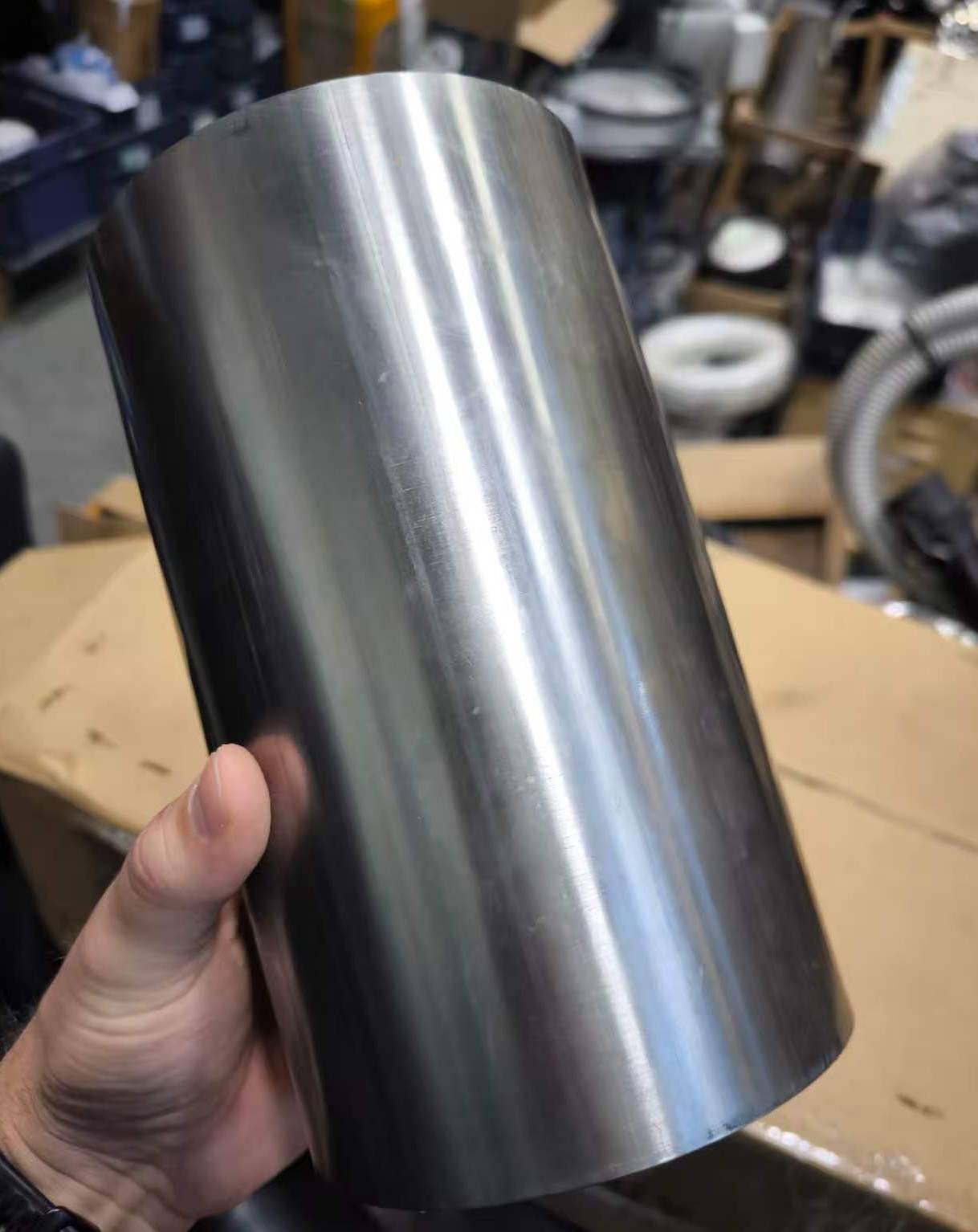
Stainless steel pipe laser welding
2.Stainless Steel Pipe Fittings
Stainless steel pipe fittings often involve curved surfaces and multiple welding positions.Common products include:
- Elbows
- Tees
- Flanges
- Reducers
- Couplings
- Connectors
- Valves
- Tube assemblies
A rotary-axis system can handle many circular welding applications, while more complex fittings may require multi-axis or robotic laser welding.
3.Stainless Steel Sheet Metal Products
Stainless steel sheet metal is one of the most common applications for laser welding.Products include:
- Panels
- Covers
- Frames
- Enclosures
- Cabinets
- Machine housings
- Control boxes
- Decorative panels
Laser welding can help reduce thermal deformation and minimize grinding or other post-welding finishing for suitable applications.
4.Stainless Steel Cabinets and Enclosures
Stainless steel is widely used for electrical cabinets, control enclosures, equipment housings, and industrial boxes.Typical products include:
- Electrical cabinets
- Control cabinets
- Instrument enclosures
- Stainless steel boxes
- Machine enclosures
- Equipment covers
CNC welding provides repeatable welding paths for repeated production. Dedicated fixtures can maintain the position of panels and corners during welding.
5.Stainless Steel Kitchen and Food Equipment
Stainless steel is extensively used in commercial kitchens and food-processing equipment.Applications include:
- Stainless steel sinks
- Kitchen counters
- Food containers
- Catering equipment
- Commercial kitchen equipment
- Food-processing machines
- Stainless steel shelves
- Equipment frames
For these products, weld appearance, dimensional accuracy, and surface condition can be important in addition to weld strength.
6.Stainless Steel Mesh Cylinders and Screens
Laser welding can also be used for stainless steel mesh products and assemblies.Typical applications include:
- Mesh cylinders
- Filter structures
- Screens
- Mesh tubes
- Filter housings
- Wire mesh assemblies
Because mesh products may contain thin wires or small cross-sections, controlled heat input is important. CNC motion can help maintain consistent welding positions across repeated products.
5.Stainless Steel Industrial Equipment
Stainless steel is widely used in industrial equipment because of its corrosion resistance and durability.Laser welding can be applied to:
- Machine frames
- Housings
- Tanks
- Containers
- Industrial covers
- Processing equipment
- Fluid-handling components
- Mechanical assemblies
The required welding process depends on whether the application prioritizes penetration, sealing, appearance, or production efficiency.
6.Stainless Steel Medical Equipment
Stainless steel is also used in medical equipment and precision components.Potential applications include:
- Medical equipment housings
- Surgical instrument components
- Stainless steel tubes
- Precision assemblies
- Medical device components
- Fluid-handling components
Medical applications may require higher levels of dimensional accuracy, surface quality, cleanliness, and process repeatability. CNC and robotic laser welding can help provide consistent welding paths for production applications.
7.Stainless Steel Automotive Components
Stainless steel is used in selected automotive components where corrosion resistance, strength, temperature resistance, or other material properties are required.Applications can include:
- Exhaust components
- Tubular components
- Brackets
- Housings
- Heat-related components
- Automotive hardware
- Precision assemblies
For higher-volume production, robotic laser welding can be combined with dedicated fixtures, positioners, vision systems, and automatic loading and unloading.
CNC laser Welding Machines For Stainless Steel Welding
Different stainless steel products require different machine architectures.
3-Axis CNC Laser Welding Machine
A 3-axis system is suitable for relatively simple welding paths on flat or three-dimensional workpieces.Typical applications:
- Sheet metal
- Cabinets
- Panels
- Enclosures
- Flat frames
- General fabricated components
4-Axis CNC Laser Welding Machine
A fourth rotary axis adds controlled rotation of the workpiece.It is suitable for:
- Tubes
- Pipes
- Shafts
- Rings
- Flanges
- Cylindrical housings
- Circular welds
This configuration is particularly useful when the workpiece itself needs to rotate during welding.
5-Axis CNC Laser Welding
A 5-axis system can provide additional flexibility for complex geometries and welding positions.
It can be considered when a conventional XYZ system cannot easily maintain the required welding orientation.
6-Axis Robot Laser Welding
For large, complex, or high-volume products, a 6-axis robot can provide a larger working envelope and more flexible movement.A robotic cell can include:
- Industrial robot
- Laser source
- Welding head
- Positioner
- Fixtures
- Safety enclosure
- Vision system
- Automatic loading and unloading
The appropriate configuration depends on the product size, welding path, production volume, and automation requirements.
CNC Laser Welding or Handheld Laser Welding for Stainless Steel?
Both technologies can weld stainless steel.The choice depends on the manufacturing process.
Handheld systems provide:
- High flexibility
- Simple operation
- Easy product changeover
- Operator-controlled welding movement
- Suitability for small and medium production
- Lower system complexity
They are useful when the operator needs to weld different products without extensive programming.
CNC systems provide:
- Repeatable welding paths
- Controlled welding speed
- Automated movement
- Higher production consistency
- Dedicated fixtures
- Rotary-axis welding
- Multi-axis movement
- Easier integration with automation
CNC is particularly attractive when the same product needs to be produced repeatedly.
The important point is that CNC is not automatically better than handheld welding, and handheld welding is not automatically better than CNC welding.They are designed for different production methods.
For stainless steel products close to the upper thickness limit, CNC systems should normally have sufficient power margin because the operator cannot continuously compensate for process variations in the same way as with a handheld system.
How to Choose the Right Laser Power for Stainless Steel
Laser power should be selected based on more than material thickness.When evaluating a stainless steel laser welding project, ZS Machinery normally considers:
Material
- 304
- 304L
- 316
- 316L
- 430
- Other stainless steel grades
Thickness
The thickness of the material is one of the first parameters to consider, but it should be evaluated together with the joint.
Joint Design
Butt joints, lap joints, corner joints, fillet joints, and other configurations can require different processes.
Required Penetration
A surface weld and a full-penetration weld are not the same application.
Production Volume
A manually operated process may be suitable for flexible production, while high-volume production may justify CNC or robotic automation.
Product Geometry
Flat sheet, tubes, fittings, cabinets, and complex three-dimensional components require different machine structures.
Welding Appearance
Visible stainless steel products may require particularly careful control of heat input and weld appearance.
Automation Requirements
The final system may include:
- Rotary axis
- Fixtures
- Wire feeder
- Vision
- Automatic loading
- Automatic unloading
- Positioners
- Safety enclosure
- Robotic integration
Why Testing Is Important Before Buying a CNC Stainless Steel Laser Welding Machine
The best way to determine whether a machine is suitable for a specific stainless steel product is to test the actual workpieceA specification sheet cannot fully describe the welding behavior of every product.For example, two stainless steel components may both be 4 mm thick but require completely different welding processes because of differences in:
- Joint design
- Geometry
- Gap
- Required penetration
- Welding direction
- Fixture
- Surface condition
- Production speed
A sample test can evaluate:
- Penetration
- Weld appearance
- Welding speed
- Distortion
- Heat-affected area
- Weld strength
- Spatter
- Gas protection
- Filler wire requirement
- Cycle time
For CNC systems, testing should ideally include the intended fixture and motion method rather than testing only a simple handheld weld.
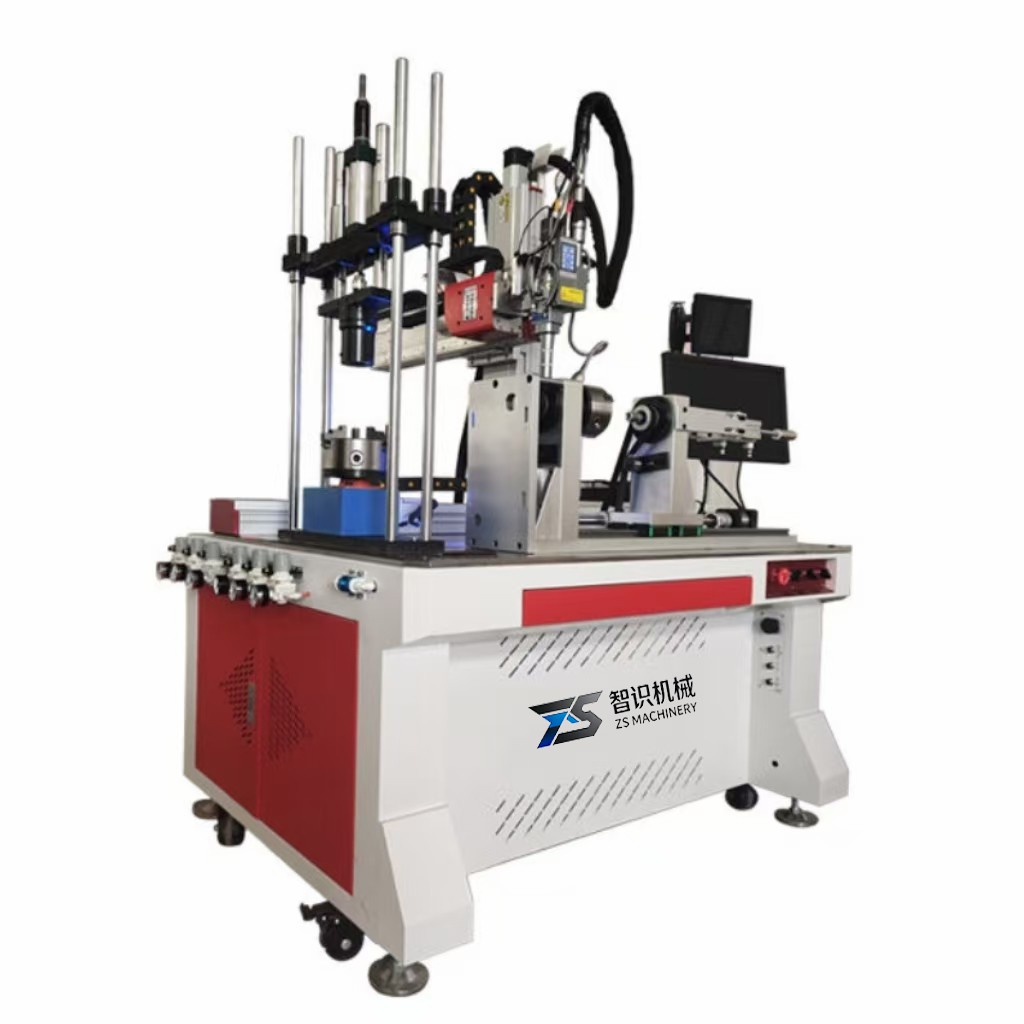
6-axis CNC laser welding machine
Why Choose ZS Machinery for Stainless Steel Laser Welding?
ZS Machinery focuses on complete laser processing solutions rather than simply supplying a laser source and welding head.Our experience includes stainless steel welding applications involving:
- Stainless steel tubes
- Pipe fittings
- Kitchen equipment
- Sheet metal
- Electrical cabinets
- Stainless steel enclosures
- Mesh cylinders
- Industrial equipment
- Automotive-related components
- Precision metal parts
Different products require different machine configurations.ZS Machinery can configure the system according to the actual application, including:
- Laser power
- Laser source
- Welding head
- CNC controller
- Motion axes
- Servo motors
- Transmission system
- Rotary axis
- Fixtures
- Water chiller
- Shielding gas system
- Wire feeder
- Vision system
- Safety enclosure
- Automation
The objective is to provide enough process margin and the appropriate machine architecture for stable and repeatable production.
Frequently Asked Questions About CNC Laser Welding Stainless Steel
Can stainless steel be welded with a CNC laser welding machine?
Yes. Stainless steel is one of the established materials for laser welding. Common grades such as 304, 304L, 316, 316L, and 430 can be processed with suitable laser welding systems.
The exact process depends on the material grade, thickness, joint design, and required weld quality.
What is the best laser power for stainless steel?
There is no single best laser power for all stainless steel applications.
As a practical ZS Machinery reference, 1500W can be used for applications up to around 3 mm, 2000W up to around 4 mm, and 3000W up to around 6 mm under suitable conditions.For CNC production, it is recommended to leave sufficient process margin rather than operating continuously at the upper limit.
Can a 1500W laser weld 3 mm stainless steel?
A 1500W system can be suitable for stainless steel applications around 3 mm under appropriate conditions.
However, actual performance depends on the joint, penetration requirement, welding speed, material grade, and other process parameters.
Can 304 stainless steel be laser welded?
Yes. 304 is one of the most common stainless steel grades used for laser welding.
It is widely used for sheet metal, tubes, kitchen equipment, cabinets, industrial equipment, and other fabricated products.
Can 316L stainless steel be laser welded?
Yes. 316L is widely used in laser welding applications where corrosion resistance and welded construction are important.
It can be found in medical, food, chemical, pharmaceutical, and other industrial applications.
Does stainless steel laser welding require filler wire?
Not always.
Some well-fitted stainless steel joints can be welded without filler wire. Filler wire may be added when the joint gap, weld geometry, reinforcement, or specific material requirements make it necessary.
Is CNC laser welding better than handheld laser welding for stainless steel?
They serve different production requirements.
Handheld welding offers flexibility and direct operator control. CNC welding provides controlled motion and repeatability.
The appropriate solution depends on the product, production volume, geometry, required consistency, and automation level.
Can a CNC laser welding machine weld stainless steel tubes?
Yes.
For cylindrical tubes and circular welds, a rotary axis can be integrated into the CNC system so that the workpiece rotates under programmed control.
What information should I provide when asking for a stainless steel laser welding machine?
The most useful information includes:
- Stainless steel grade
- Material thickness
- Product dimensions
- Product photos or drawings
- Joint design
- Required penetration
- Welding length
- Production quantity
- Desired welding speed
- Whether filler wire is required
- Whether automatic loading and unloading is required
Providing an actual sample is even better because the welding process can then be evaluated directly.
Conclusion
CNC laser welding stainless steel is a mature and versatile application for industrial laser welding.
Common stainless steel grades such as 304, 304L, 316, 316L, and 430 can be used for a wide range of products, including tubes, pipe fittings, kitchen equipment, sheet metal, electrical cabinets, enclosures, mesh cylinders, industrial equipment, medical components, and automotive parts.
If you are planning to purchase a Stainless Steel Laser Welding Machine or CNC Stainless Steel Laser Welding Machine, contact ZS Machinery with your product information. We can evaluate the application and recommend the appropriate laser power, CNC structure, rotary axis, welding head, fixture, wire feeder, and automation configuration for your stainless steel welding project.