
CNC Laser Welding in Consumer Electronics and 3C Industry
The consumer electronics industry, commonly referred to as the 3C industry — Computers, Communications, and Consumer Electronics, requires increasingly precise manufacturing processes as electronic products become smaller, thinner, lighter, and more highly integrated.Smartphones, tablets, laptops, smartwatches, wireless earbuds, cameras, communication devices, and other electronic products contain many small metal and plastic components that must be joined accurately without damaging nearby electronic parts.
CNC laser welding is used in 3C manufacturing because it can provide concentrated heat input, precise welding paths, non-contact processing, and repeatable automated operation. Depending on the product, laser welding can weld structural components, battery components, connectors, shielding parts, camera-related assemblies, miniature motors, heat dissipation components, and other precision parts.
Unlike general metal fabrication, 3C manufacturing often involves small components, thin materials, tight positioning requirements, short production cycles, and heat-sensitive electronic parts. This makes the design of the complete CNC laser welding system particularly important.
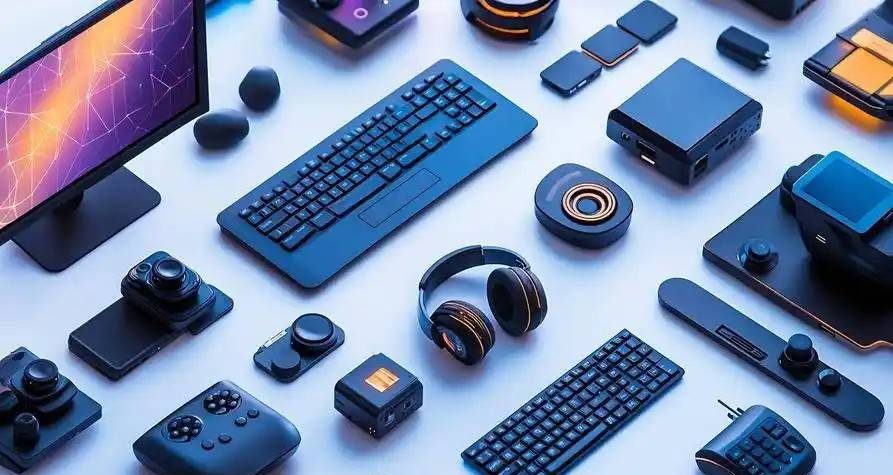
Consumer electronics industry
Why Is Laser Welding Used in the 3C Industry?
3C products have several characteristics that make conventional joining processes difficult.
Components are becoming smaller while the number of functional parts inside each product continues to increase. A welding process may need to create a small and reliable joint only a short distance from a sensor, camera module, flexible circuit, connector, or other heat-sensitive component.
Laser welding provides a concentrated energy source that can be accurately positioned on the required welding area. Because the process is non-contact, there is no welding electrode or tool physically pressing against the component during the welding process.The main advantages for 3C manufacturing include:
- High positioning accuracy
- Localized heat input
- Small heat-affected area
- Non-contact processing
- Repeatable welding paths
- Good weld appearance
- Compatibility with small and complex components
- Easy integration with vision systems
- Compatibility with automated production lines
- High repeatability for mass production
For precision electronic components, controlling heat input is particularly important because excessive heat can affect surrounding materials or components. Laser welding and other laser joining processes are therefore used in applications where localized energy delivery is valuable.
CNC Laser Welding Applications in Consumer Electronics
1.Smartphone and Tablet Structural Components
Smartphones and tablets contain various metal structural components that require precise joining during assembly.Applications can include:
- Smartphone middle frames
- Internal brackets
- Metal supports
- Structural frames
- Metal housings
- Internal reinforcement parts
- Button and bracket components
- Small structural assemblies
Laser welding can create localized joints while reducing mechanical contact with the workpiece. For components with strict dimensional and appearance requirements, CNC motion and dedicated fixtures can help maintain consistent welding positions from one part to the next.
For high-volume production, a CNC laser welding system can also be integrated with automatic loading, unloading, positioning, and inspection systems.Some consumer-electronics laser systems specifically use galvanometer scanning, CNC motion stages, and CCD vision positioning for smartphone structural components.
2.Camera Modules and Precision Camera Components
Camera modules are among the more precision-sensitive components in modern smartphones, tablets, laptops, and other electronic products.Laser joining can be used for selected metal components associated with camera assemblies, such as:
- Camera brackets
- Metal frames
- Sensor supports
- Small structural components
- Precision positioning parts
The main challenge is controlling the welding position and heat input so that nearby optical or electronic components are not unnecessarily affected.For this type of application, a CNC system may combine:
- Precision motion stages
- Laser welding head
- Galvanometer scanner
- CCD or vision positioning
- Dedicated fixtures
- Programmable welding paths
- Process monitoring
The exact process depends heavily on the camera-module construction and materials. Not every camera component is suitable for direct laser welding, so application testing is normally required.
3.VCM and Miniature Motor Components
Voice coil motors (VCMs), vibration motors, and other miniature motors are widely used in smartphones, cameras, autofocus systems, and other compact electronic products.Laser welding can be applied to selected metal components such as:
- Motor housings
- Brackets
- Metal supports
- Precision motor components
- Electrical connection components
CNC motion or galvanometer-controlled laser systems can position the beam precisely according to the programmed welding pattern. Industry application references specifically identify VCMs, motors, and other functional components as consumer-electronics laser processing applications.
4.Connectors and Electrical Contact Components
Connectors are another important application area in 3C manufacturing.Examples include:
- USB-related components
- Data connectors
- Charging connectors
- Metal terminals
- Connector housings
- Shielding components
- Small electrical contact parts
Some connector components require a combination of electrical conductivity, mechanical strength, dimensional accuracy, and controlled heat input.CNC Laser welding can be used for selected metal joints where localized processing is required. For copper and other highly reflective materials, the laser source and process parameters need to be selected according to the specific application. Advanced laser systems may use specialized wavelengths or beam-control technologies for challenging copper applications.
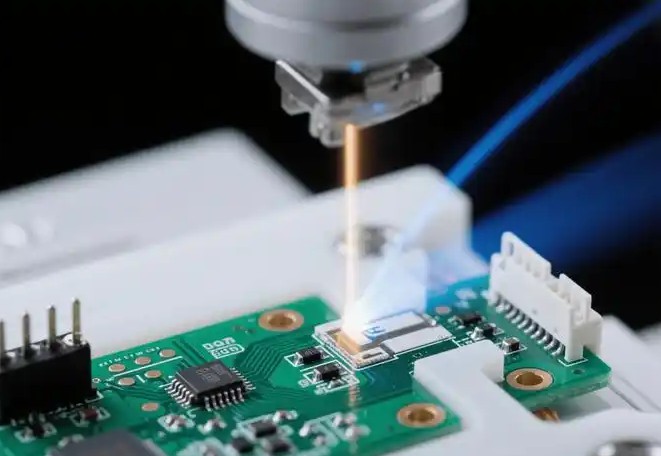
Laser welding in consumer electronics
5.Electronic Shielding Components
Modern electronic devices contain many components that require electromagnetic shielding.Applications can include:
- EMI shielding components
- RF shielding covers
- Shielding frames
- Metal shielding cans
- Small shielding structures
These components are often thin and relatively small, making heat control and dimensional accuracy important.
A CNC or galvanometer-based laser welding system can follow programmed welding paths around the shielding component. Fixtures keep the parts aligned while the laser creates the required seam or spot pattern.The process can be particularly useful when manufacturers need consistent joints across large production volumes.
6.Fingerprint and Sensor Modules
Consumer electronics contain numerous sensors for fingerprint recognition, proximity detection, optical sensing, motion detection, and other functions.Laser welding may be used for selected metal housings, brackets, frames, supports, and other structural components within these modules.Typical requirements include:
- Precise positioning
- Small weld size
- Low thermal influence
- Repeatable processing
- Stable mechanical connection
- Good appearance
As sensor assemblies become smaller and more integrated, the welding process must be carefully matched to the component structure and material combination.
7.Heat Sinks and Thermal Management Components
Heat dissipation has become increasingly important as processors, communication modules, cameras, and other electronic components become more powerful.CNC Laser welding can be used for selected metal heat-dissipation components, including:
- Heat sinks
- Cooling plates
- Metal thermal structures
- Heat spreader components
- Cooling-related assemblies
Depending on the design, the welding process may involve aluminum, copper, stainless steel, or combinations of different materials.Copper is particularly challenging because of its high reflectivity and thermal conductivity, so the laser source, beam characteristics, power density, and process parameters need to be matched to the application.
8.3C Battery Components
Small batteries used in smartphones, tablets, laptops, smartwatches, wireless earbuds, and other portable electronic products require reliable electrical connections.Laser welding can be used for selected battery components such as:
- Battery tabs
- Terminal connections
- Nickel or nickel-plated components
- Aluminum components
- Copper connections
- Battery housing components
3C batteries are generally smaller than automotive batteries, but they can have similarly demanding requirements for controlled heat input and reliable electrical connections. Industry application references include button batteries, battery tabs, and other small battery components in consumer electronics.
Battery welding requires particular care because excessive heat, spatter, penetration, or process instability can damage sensitive internal components. The actual welding method therefore needs to be developed around the battery chemistry, cell construction, materials, thickness, joint design, and required electrical performance.
9.Smartwatch and Wearable Device Components
Smartwatches, fitness trackers, wireless earbuds, and other wearable devices combine small housings, sensors, batteries, speakers, antennas, and other miniature components in a compact space.Laser welding can be used for selected:
- Metal frames
- Small housings
- Sensor supports
- Battery connections
- Acoustic components
- Structural brackets
- Metal sealing or joining components
For these products, appearance and dimensional consistency can be just as important as mechanical strength.
CNC laser welding allows the welding path and process parameters to be programmed so that repeated parts can be processed under the same conditions.
10.Acoustic Components and Speaker Assemblies
Small speakers, microphones, acoustic modules, and related components are widely used in smartphones, tablets, laptops, earbuds, smartwatches, and other consumer electronics.
Laser welding can be considered for selected metal structural components and acoustic assemblies where a precise, localized joining process is required.
The welding system may use precision fixtures and controlled laser movement to avoid unnecessary deformation of thin components.Some 3C laser application references specifically identify acoustic components and similar miniature structures as laser-processing applications.
11.Laptop and Computer Components
Laptops, desktop computers, tablets, and other computing devices contain many metal structural and functional components.Laser welding applications can include:
- Laptop structural frames
- Metal brackets
- Internal supports
- Cooling components
- Shielding parts
- Connector components
- Small metal housings
- Battery-related components
The large variety of component geometries means that the welding system may use different fixtures, CNC stages, rotary axes, or laser scanning systems depending on the product.For mass production, automatic workpiece handling and vision positioning can further improve production consistency.
12.Communication Equipment and Electronic Housings
Communication equipment, network devices, wireless products, and other electronic systems often use metal housings and internal structural components.Applications may include:
- Communication-device housings
- RF shielding components
- Metal brackets
- Connector assemblies
- Heat dissipation structures
- Small electronic enclosures
Laser welding can provide localized joining while maintaining the dimensional accuracy of the housing.
For sealed electronic products, the welding process may also be developed around sealing requirements. The exact requirements depend on the product’s environmental protection and sealing specification.
CNC Laser Welding Machines for Consumer Electronics
Consumer electronics manufacturing requires different laser welding machine configurations depending on the product size, geometry, precision, and production environment.
For standard components, 3-axis CNC laser welding machines can provide accurate and repeatable welding paths. For cylindrical, multi-angle, or more complex components, 4-axis, 5-axis, 6-axis, and robotic laser welding systems can provide additional motion flexibility.
For precision 3C products, however, the welding machine may need more than CNC motion. Some applications have strict requirements for cleanliness, dust control, and contamination prevention, especially when welding small electronic components or products that are sensitive to particles.
For these applications, ZS Machinery can provide enclosed laser welding machines and clean welding cells with integrated fixtures, vision positioning, process monitoring, and automated loading or unloading. Depending on the production requirements, the enclosure can be designed with controlled airflow, filtration, and other environmental-control features.
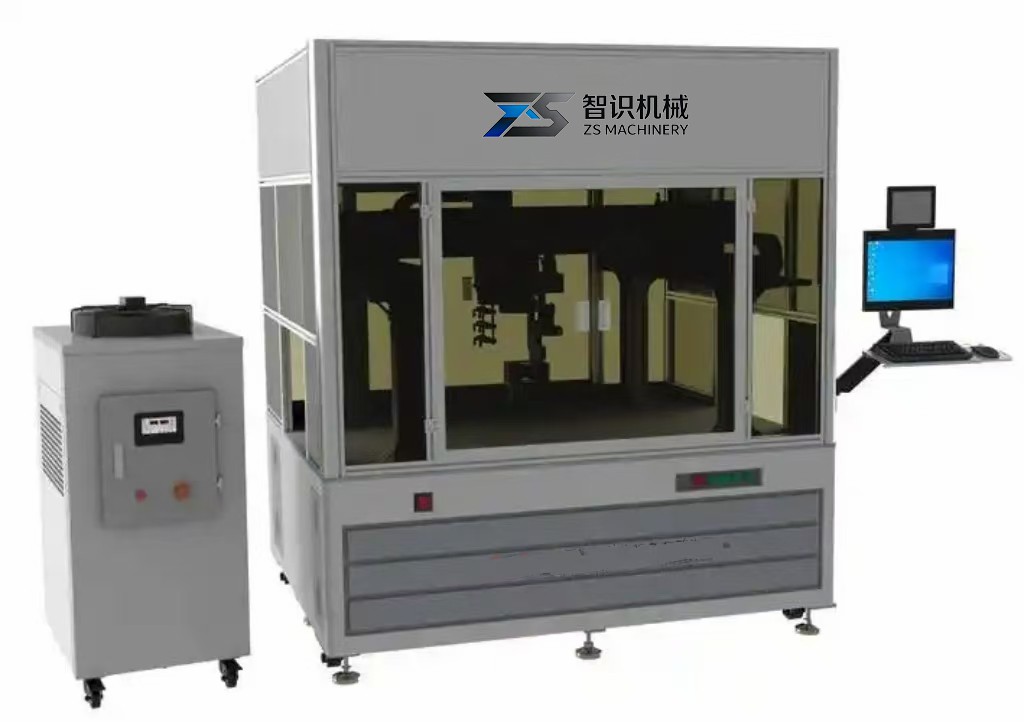
Enclosed CNC laser welding machine
Vision Positioning for Consumer Electronics Welding
Vision systems are particularly useful when welding small 3C components.A CCD or machine-vision system can help identify:
- Workpiece position
- Welding position
- Component edges
- Reference points
- Fixture position
- Product orientation
The vision system can be used together with CNC motion or a galvanometer scanner to position the laser according to the actual workpiece.This is important because 3C components can be small enough that even a relatively small positioning deviation may affect the final assembly.
However, vision does not replace proper fixture design. Fixture accuracy, part positioning, vision recognition, and CNC motion must work together to achieve repeatable welding.
CNC Laser Welding vs. Laser Soldering in 3C Manufacturing
Laser welding and laser soldering are both used in electronics manufacturing, but they are not the same process.
Laser welding generally creates a metallurgical joint by melting the base materials or compatible joining materials.
Laser soldering uses a solder material with a lower melting point to create the electrical or mechanical connection.
In 3C manufacturing, both processes can appear in the same production environment.
For example, laser soldering may be used for electronic assembly and certain PCB-related connections, while laser welding can be used for metal structural components, battery tabs, shielding parts, housings, connectors, and other suitable components.
Therefore, the correct process should be selected based on the actual joint rather than simply choosing laser welding for every electronic component.
Automation of CNC Laser Welding in 3C Manufacturing
High-volume 3C manufacturing often requires more than a standalone welding machine.A complete automated system may include:
Feeding → Positioning → Vision Inspection → Laser Welding → Quality Inspection → Unloading
Depending on production requirements, the system can also integrate:
- Automatic feeding
- Robotic handling
- Precision fixtures
- Multi-station worktables
- Vision alignment
- In-line inspection
- Barcode or QR-code tracking
- Process data recording
- Automatic unloading
This allows laser welding to become part of a larger production system rather than an isolated process.For consumer electronics, where product models can change frequently, the ability to switch programs, fixtures, and welding paths can also be important.
Materials Used in 3C Laser Welding
Consumer electronics use a wide range of materials.Common metal materials include:
- Stainless steel
- Aluminum
- Copper
- Nickel
- Nickel-plated steel
- Low-carbon steel
- Titanium
- Other specialized alloys
Plastic components may also be present in the overall assembly, although plastic laser welding normally uses a different process configuration from metal laser welding.Material selection has a direct influence on the welding process.
For example, stainless steel is generally easier to process than highly reflective copper, while aluminum requires attention to its thermal properties, surface condition, joint design, and potential porosity.Dissimilar-metal joints can be even more demanding and require application-specific testing.
How to Choose a CNC Laser Welding Machine for 3C Products
The correct CNC laser welding machine should be selected according to the actual product rather than the industry name alone.Important factors include:
1. Product and Component Size
Small components may require precision stages or galvanometer scanning, while larger assemblies may require XYZ motion or robotic systems.
2. Material
Stainless steel, aluminum, copper, nickel, and dissimilar metals require different process development.
3. Material Thickness
Thin 3C components require careful control of laser power, focus, speed, and energy input.
4. Joint Type
The machine should be selected according to whether the application requires:
- Spot welding
- Continuous seam welding
- Overlap welding
- Circumferential welding
- Butt welding
- Fillet welding
- Precision micro-welding
5. Production Volume
Prototype and small-batch production may use a simpler CNC system, while mass production may require automated feeding, multiple stations, vision, and in-line inspection.
6. Positioning Accuracy
For miniature components, the complete system accuracy — including fixture, motion system, vision, and laser delivery — can be more important than the laser source alone.
7. Heat Sensitivity
If sensitive components are located close to the welding area, the process must be developed around controlled and localized heat input.
Why Choose ZS Machinery for 3C Laser Welding?
3C laser welding is not simply a matter of selecting a laser source and installing a welding head.The complete system needs to be matched to the product, including the laser source, welding head, CNC controller, motion system, fixture, vision system, cooling system, shielding gas, electrical components, and automation.
ZS Machinery provides customized laser welding solutions for precision metal components and consumer-electronics applications.Depending on the product, we can develop systems using:
- Precision CNC laser welding machines
- Galvanometer laser welding systems
- Rotary-axis CNC systems
- Multi-axis laser welding systems
- Automated welding cells
- Vision-assisted welding systems
- Customized fixtures
- Automatic loading and unloading systems
The final configuration should be determined by the actual workpiece, material, thickness, welding position, production volume, and quality requirements.
For 3C applications, we recommend testing the actual product before final machine selection. This allows the welding process, laser power, optical configuration, fixture, motion system, and automation level to be matched to the real production requirements.
Conclusion
CNC laser welding provides a precise and repeatable joining solution for many Consumer Electronics and 3C applications, including smartphones, laptops, cameras, batteries, connectors, sensors, and other precision components.
The right system depends on the product, material, thickness, joint design, and production requirements. ZS Machinery can provide CNC, precision, galvanometer, multi-axis, and customized laser welding solutions based on your application.
Have a 3C product that needs laser welding? Contact ZS Machinery to discuss your application and find a suitable solution.