- Product Details
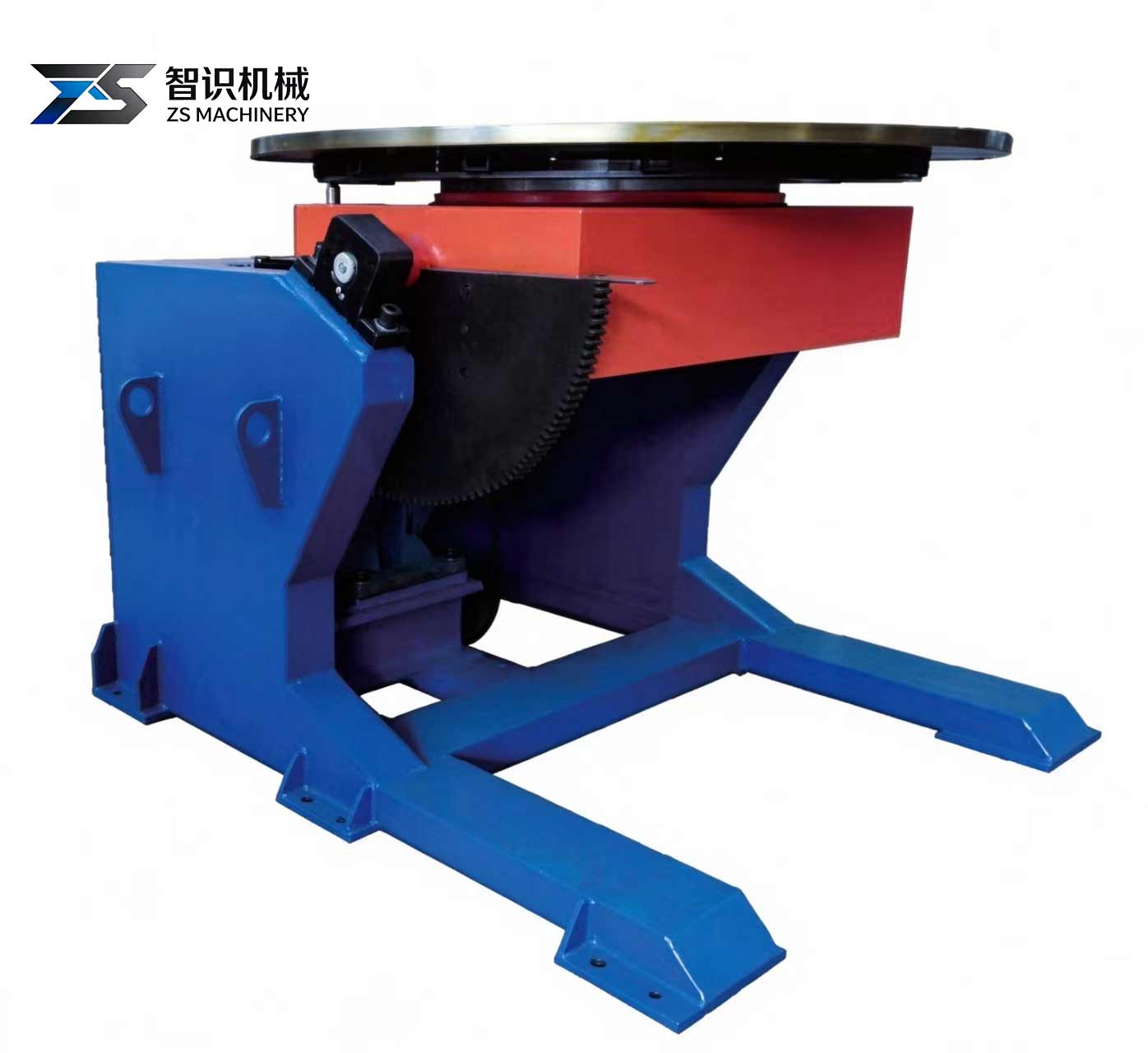
The Tilting Rotary Welding Positioner is designed to rotate and tilt large and heavy workpieces into the required welding position. With 360° horizontal rotation and 0°–120° vertical tilting, it can be used for cylindrical, round, shaft-type, disc-shaped, and other irregular workpieces.
The positioner can be used as a standalone welding positioning device or integrated into an automated welding system with a laser welding machine, TIG welding system, welding robot, or handling robot.
For larger and more complex production requirements, ZS Machinery can also design a complete robotic welding system by combining the positioner with welding robots, handling robots, customized fixtures, and welding equipment.
What Is a Tilting Rotary Welding Positioner?
A tilting rotary welding positioner is a mechanical device used to hold, rotate, and tilt a workpiece during welding.Its purpose is to bring the welding joint into a more suitable position for the welding process.
For example, when welding a large cylindrical component, continuously rotating the workpiece can allow the welding torch to remain in a relatively stable position while the workpiece moves through the welding path.
When welding a large irregular component, the tilting function can change the orientation of the workpiece so that different surfaces and welding seams can be accessed more easily.This is particularly useful when the workpiece is too large, heavy, or inconvenient to reposition manually.
The positioner itself does not determine the welding process. It can be combined with different welding technologies according to the application, including:
- Laser welding
- TIG welding
- Argon arc welding
- Robotic welding
- Other customized welding processes
The same positioning principle can therefore be used in different welding systems.
Tilting Rotary Welding Positioner
How It Works
The positioner uses two main controlled movements:
Horizontal Rotation
The worktable can rotate 360° horizontally.
When welding a cylindrical or round workpiece, the table can continuously rotate the component so that the welding gun can remain in a suitable position while the workpiece moves through the welding path.
Vertical Tilting
The worktable can tilt from 0° to 120° vertically.
This allows the operator to change the orientation of the workpiece and bring different welding surfaces into a more accessible position.The rotation and tilting movements are driven by motors with variable-frequency stepless speed control, allowing the movement speed to be adjusted according to the welding or cutting requirements.
Key Features Of This Rotary Welding Positioner
360° Continuous Worktable Rotation
The 360° rotating worktable is suitable for cylindrical and round workpieces that require circumferential welding.
The workpiece can rotate while the welding torch remains positioned at a suitable location.
0°–120° Tilting Range
The tilting function allows the workpiece to be repositioned for different welding surfaces and joint orientations.
This is especially useful for large components where manual repositioning would be difficult.
Designed for Large and Heavy Workpieces
The available load capacity covers approximately 1.2 to 5 tons, with different table diameters available for different workpiece sizes.
For larger or special-shaped components, the positioner can be customized according to the actual load, dimensions, center of gravity, and welding requirements.
Flexible Workpiece Clamping
Different workpieces require different workholding methods.
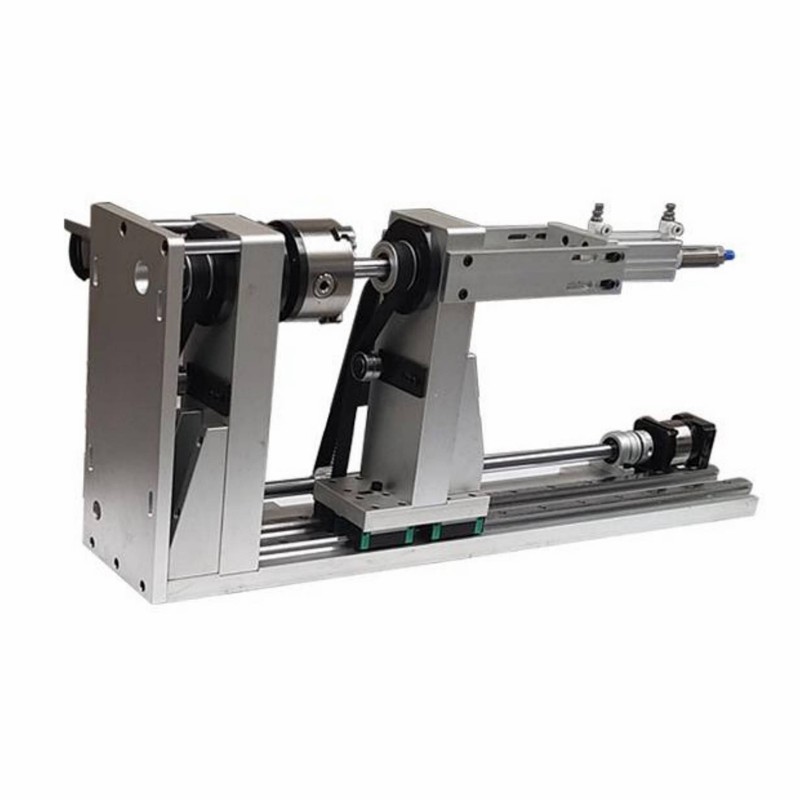
The positioner can be configured with:
- Chucks
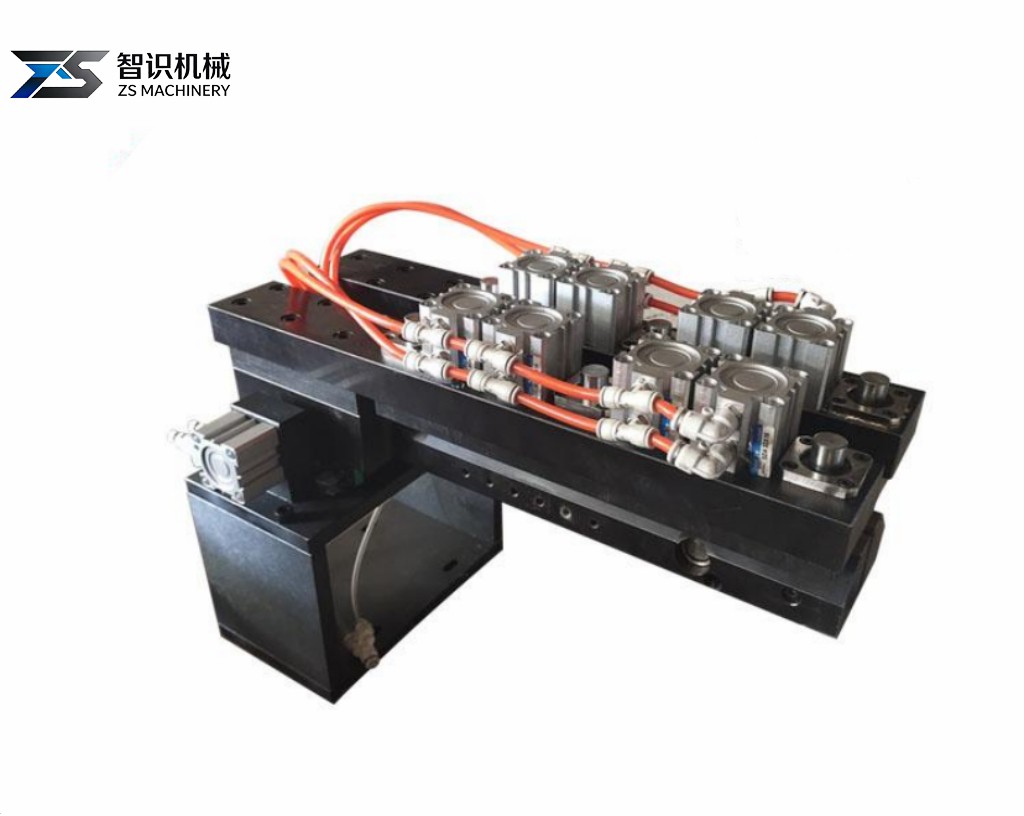
- Pneumatic clamping
- Customized fixtures
- Special workholding structures
The clamping solution can be designed around the actual geometry of the workpiece.
Suitable for Different Welding Processes
The positioner is not limited to one welding technology.It can be used together with:
- Laser welding systems
- TIG welding systems
- Argon arc welding equipment
- Welding robots
- Other customized welding equipment
This makes it suitable for different production environments and welding requirements.
Suitable for Automated Welding
The positioner can serve as the workpiece positioning unit in a robotic welding cell.A welding robot can perform the welding operation while the positioner rotates or tilts the workpiece.The robot and positioner can be configured to work together according to the welding path and workpiece geometry.
Applications
The tilting rotary welding positioner is mainly suitable for large, heavy, cylindrical, round, shaft-type, and irregular workpieces.Typical applications include:
Large Cylindrical Workpieces
For large cylindrical components, the rotary table can continuously rotate the workpiece during circumferential welding.
The welding system can maintain a suitable welding position while the workpiece rotates.
Shafts and Rotary Components
Shafts and other rotary components can be mounted on the positioner and rotated according to the welding path.
Discs and Round Components
Round and disc-shaped components can be positioned and rotated for welding around their circumference or at different locations.
Large Irregular Workpieces
For irregular components, the 0°–120° tilting function can help reposition the workpiece and provide better access to different welding areas.
Robotic Welding
For production environments that require repeatable welding, the positioner can be combined with a welding robot.
The robot performs the welding while the positioner controls the workpiece orientation.
How to Choose the Right Welding Positioner
Selecting a welding positioner is not simply a matter of choosing a model based on the workpiece weight.
Several factors should be considered.
1. Workpiece Weight
First, determine the total weight of the workpiece and fixture.The positioner’s rated load capacity needs to provide sufficient capacity for the actual application.
2. Workpiece Dimensions
The workpiece diameter, length, height, and overall dimensions should be considered together with the table diameter and center height.Large workpieces may require a larger table or customized supporting structure.
3. Center of Gravity and Eccentricity
A workpiece may not have its center of gravity directly above the center of rotation.This is especially important for large or irregular components.The eccentricity of the load needs to be considered when selecting the positioner.
4. Does the Workpiece Need to Rotate?
If the welding process requires circumferential welding around a cylindrical component, a rotary table can rotate the workpiece while the welding torch remains in a suitable position.
5. Does the Workpiece Need to Tilt?
If different welding surfaces need to be repositioned, the tilting function can bring the welding joint into a more accessible orientation.
6. What Welding Process Will Be Used?
The required configuration may differ depending on whether the positioner is used with:
- Laser welding
- TIG welding
- Argon arc welding
- Robotic welding
The welding speed, torch position, rotation speed, and required coordination should be considered together.
7. Manual or Automatic Welding?
For manual welding, the positioner can help the operator bring the workpiece into a more comfortable and accessible welding position.
For automated welding, the positioner needs to be considered as part of the entire system and coordinated with the welding robot or welding equipment.
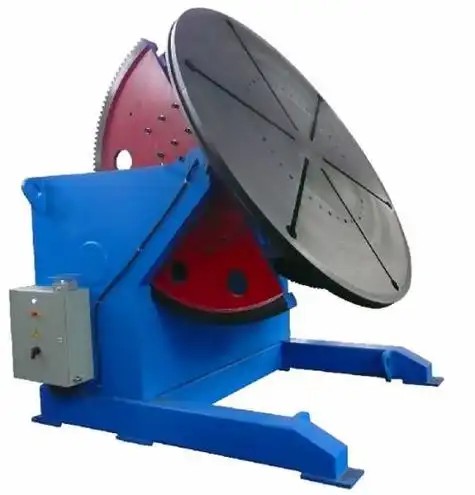
Rotary Welding Positioner
Customized Welding Automation Solutions
For customers who need more than a standalone positioner, ZS Machinery can design a complete welding automation solution around the workpiece.
A customized system may combine:
- Tilting rotary welding positioner
- Welding robot
- Handling robot
- Laser welding system
- TIG welding system
- Customized fixtures
- Pneumatic clamping
- Welding gun
- Control system
- Safety enclosure
- Automatic loading and unloading
The exact configuration depends on the workpiece and production process.
For example, a handling robot can pick up a large workpiece and place it onto the positioner. The fixture then clamps the component securely. The welding robot moves into the welding position while the positioner rotates or tilts the workpiece according to the welding path.
This creates a coordinated system in which the robot controls the welding operation and the positioner controls the workpiece orientation.
Why Choose ZS Machinery
At ZS Machinery, we focus on building welding equipment around the actual requirements of the workpiece.A welding positioner is not simply selected by its maximum load capacity. The table diameter, center height, eccentricity, rotation speed, tilting range, clamping method, and integration with the welding system all affect the final configuration.
We can help evaluate the workpiece and determine the appropriate positioner model and configuration for your welding application.Provide us with your workpiece drawing, dimensions, weight, material, welding locations, and production requirements, and we can help determine the suitable welding positioner and integration method.
Contact Us
Looking for a tilting rotary welding positioner for large or heavy workpieces?
Whether you need a standalone positioner for manual welding or a complete automated system with a welding robot, handling robot, laser welding system, or TIG welding system, ZS Machinery can develop a configuration around your application.
Send us your workpiece drawing, dimensions, weight, welding locations, and production requirements.
Talk to ZS Machinery about your welding positioner and automation project.