
CNC Laser Welding for Aerospace Industry
CNC Laser welding is one of the technologies being developed and applied for precision joining of aerospace materials. Research and industrial development in this field includes aluminum alloys, titanium, nickel-based materials, carbon-fiber-reinforced composites, and other lightweight materials. Aerospace laser welding applications can include structural components, tubes, tanks, heat exchangers, engine-related components, and precision assemblies.
However, aerospace welding is different from general fabrication. A laser welding machine must be selected according to the component geometry, material, joint design, production volume, accessibility, and required qualification procedures.
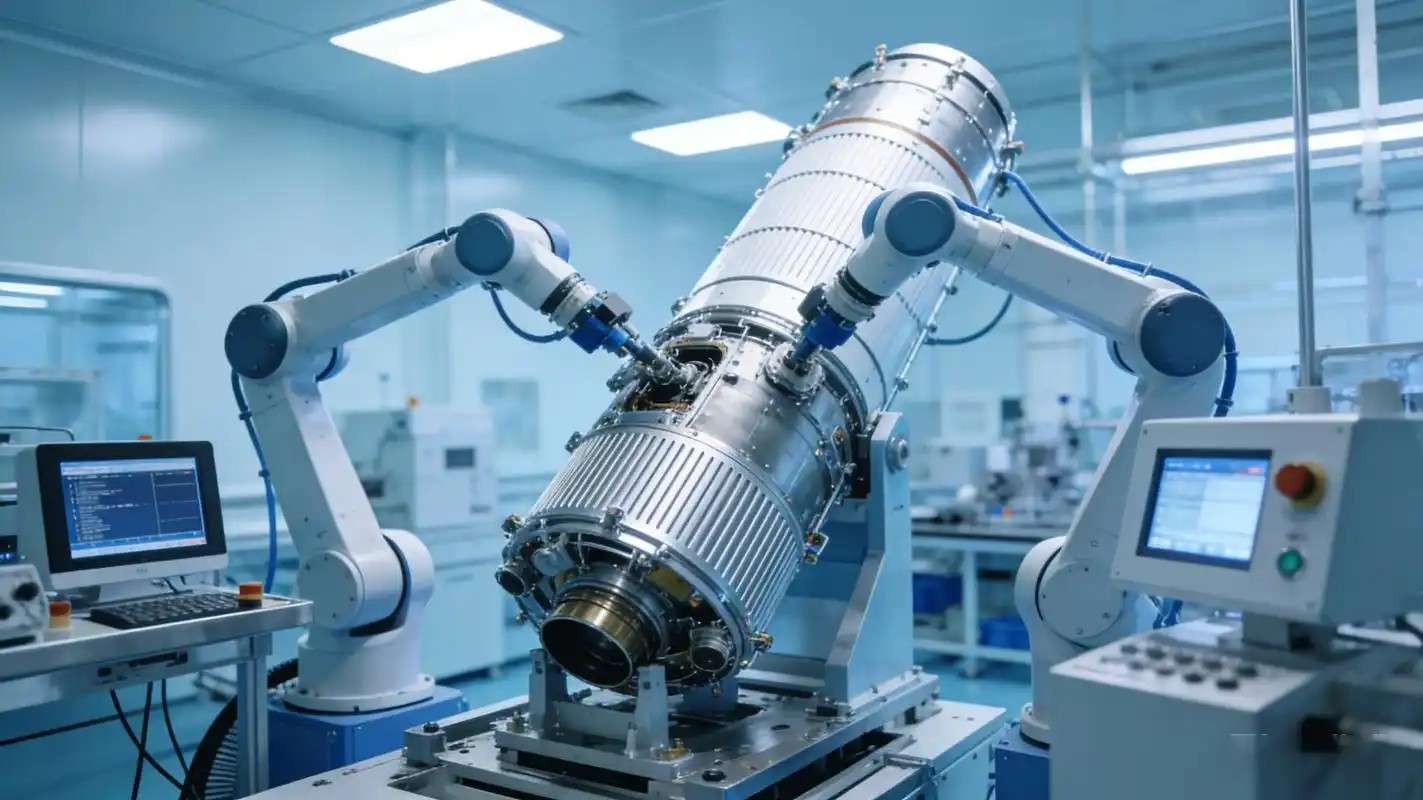
Laser welding in the aerospace industry
Why Laser Welding for Aerospace Applications?
Weight reduction is one of the major considerations in aerospace engineering. Lightweight structures can help improve payload efficiency and reduce energy consumption, but lightweight materials can also introduce welding challenges.Aluminum alloys, titanium alloys, and composite materials require carefully controlled joining processes. Laser welding provides a concentrated heat source, allowing heat to be localized around the joint instead of heating a large surrounding area.
This can provide several potential advantages for suitable aerospace components:
- Concentrated heat input
- Small heat-affected areas
- Reduced thermal distortion in suitable applications
- High positioning accuracy
- Non-contact welding
- Programmable welding paths
- Compatibility with CNC and robotic automation
- Suitability for thin-wall and precision components
- Potential for integration with sensors and process monitoring
However,laser welding should not be considered automatically suitable for every aerospace component. Material condition, alloy composition, joint geometry, surface preparation, shielding, clamping, laser parameters, and post-weld inspection all need to be considered.
Aerospace Components CNC Laser Welding Applications
Aerospace laser welding covers a wide range of components, from small precision parts to larger lightweight structures.
1.Aircraft Structural Components
Aircraft structures require a combination of low weight and mechanical performance.Potential laser welding applications include:
- Structural brackets
- Stiffening structures
- Frames
- Reinforcement components
- Panels
- Skin-related components
- Stringers
- Clips
- Lightweight structural assemblies
For these applications, the welding process must be developed together with joint design, clamping, thermal management, dimensional control, and inspection requirements.
2.Aerospace Brackets
Brackets are used throughout aircraft and aerospace systems to support equipment, tubes, cables, panels, and other assemblies.Laser welding can be considered for brackets manufactured from:
- Aluminum alloys
- Stainless steel
- Titanium alloys
- Nickel-based alloys
For small and medium brackets, 3-axis or 5-axis CNC systems may be appropriate depending on the joint geometry.For brackets with multiple welding directions, a 5-axis or 6-axis system can provide additional positioning flexibility.
3.Aerospace Panels and Lightweight Structures
Lightweight panels and structural components may involve thin materials and complex geometries.CNC Laser welding can provide localized heat input and programmable welding paths, which can be useful where dimensional control is important.Potential components include:
- Structural panels
- Reinforcement panels
- Lightweight frames
- Stiffeners
- Skin-related assemblies
- Honeycomb-related structures where the joining process is compatible with the component design
The actual welding configuration depends heavily on panel size, material, access, joint design, and required production accuracy.
4.Aerospace Tubes and Pipe Components
Tubing is widely used in aerospace systems for applications such as hydraulic, pneumatic, environmental-control, and other fluid or gas-management functions.Potential laser welding applications include:
- Aerospace tubes
- Pipe fittings
- Tube-to-flange assemblies
- Tube-to-end-cap joints
- Cylindrical housings
- Small pipe assemblies
- Instrumentation tubing
For rotational tube components, 4-axis CNC laser welding can be useful. More complicated tube assemblies may require 5-axis or 6-axis movement.
5.Aerospace Hydraulic Components
Hydraulic systems contain many precision tubes, fittings, housings, manifolds, and connection components.Potential laser welding applications include:
- Hydraulic tubes
- Small manifolds
- Pipe fittings
- Valve-related components
- Hydraulic housings
- Tube assemblies
For these components, dimensional accuracy and leak-tight joints may be important.Depending on the component, laser welding may be used for thin-wall precision joints where the material and joint design are suitable.
6.Aerospace Fuel Components and Tanks
Fuel and fluid-related components can require leak-tight welding and carefully controlled distortion.Potential components include:
- Fuel tanks
- Tank fittings
- Fluid containers
- Tubular components
- Tank closures
- Connection components
Laser welding has also been researched for aerospace tank structures. Fraunhofer IWS has reported laser welding work on high-strength aluminum tank structures, including processes aimed at producing tight, mechanically strong joints with reduced distortion.
For such applications, welding parameters and inspection requirements must be developed according to the actual material, geometry, and engineering specification.
7.Aerospace Heat Exchangers
Heat exchangers often contain thin sheets, tubes, channels, and complex assemblies.Potential applications include:
- Tube-to-header joints
- Thin sheet assemblies
- Aluminum heat exchanger components
- Stainless steel components
- Compact fluid channels
- Precision housings
Laser welding can provide a localized heat source for suitable thin-wall components.However, thermal deformation, joint accessibility, surface condition, and leak testing need to be considered during process development.
8.Aerospace Engine Components
Aircraft engine and propulsion systems contain components made from materials designed to withstand demanding thermal and mechanical conditions.Potential laser welding-related applications include:
- Engine housings
- Tubular components
- Fuel-related components
- Precision assemblies
- Repair and maintenance components
- Turbine-related components
Nickel-based alloys and titanium alloys can present significant welding challenges. Laser welding parameters therefore need to be developed according to the specific alloy and component geometry.For high-value engine components, process qualification and inspection are particularly important.
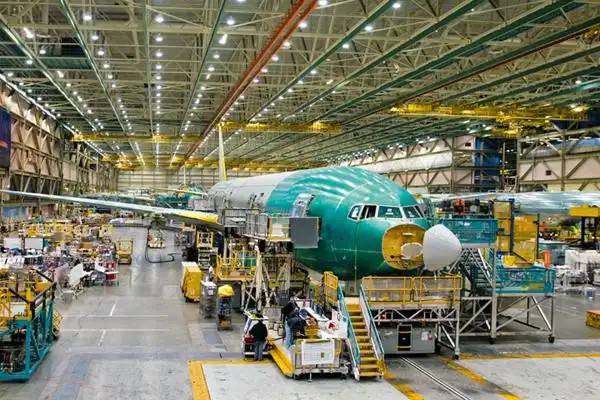
Robot Laser welding in the aerospace industry
9.Turbine Components
Turbine components can involve high-performance alloys and demanding service conditions.Depending on the component and approved process, laser technology may be considered for:
- Precision welding
- Component repair
- Localized joining
- Surface treatment
- Cladding and restoration
The process requirements can be substantially different from ordinary sheet-metal welding. For critical turbine components, application testing, metallurgical evaluation, dimensional inspection, and mechanical testing may be required before production use.
10.Aerospace Instrument and Sensor Components
Aircraft and spacecraft systems contain numerous instrument housings, sensor components, connectors, and protective enclosures.Potential laser welding applications include:
- Instrument housings
- Sensor housings
- Small cylindrical components
- Precision covers
- Sealed enclosures
- Small fittings
For small components, a precision CNC or galvanometer-based laser welding system may be considered depending on the required weld size and positioning accuracy.
11.Thermoplastic and CFRTP Aerospace Components
Thermoplastic composites are becoming an important area of lightweight aerospace research.
Carbon-fiber-reinforced thermoplastic materials can combine low weight with high mechanical performance, while thermoplastic processing can offer different manufacturing possibilities compared with traditional thermoset composite structures.Laser welding and laser-assisted joining are being investigated for these materials.Potential applications include:
- CFRTP structural components
- Thermoplastic panels
- Lightweight interior structures
- Composite housings
- Ducting
- Covers
- Fuselage-related composite structures
- Fiber-reinforced thermoplastic assemblies
Fraunhofer research has demonstrated laser-based joining of thermoplastic composite structures and has investigated laser welding technologies for large aerospace composite structures.
12.Plastic-Metal Hybrid Aerospace Components
Future aerospace structures may combine different materials to take advantage of their individual properties.Plastic-metal hybrid structures can potentially reduce weight while maintaining the required mechanical performance.Laser-based processes are being researched for joining or integrating metal and plastic components, including laser structuring of metal surfaces and laser transmission welding of fiber-reinforced materials.Potential applications may include:
- Lightweight brackets
- Hybrid structural components
- Plastic housings with metal interfaces
- Composite-metal assemblies
- Aerospace equipment housings
- Lightweight support structures
These are application-development areas rather than a universal replacement for conventional aerospace joining processes.
Recommended Laser Welding Machines for Aerospace
Different aerospace components require different levels of machine movement and automation. A small bracket and a large structural assembly should not necessarily use the same type of welding system.
3 Axis CNC Laser Welding Machine
A 3-axis CNC laser welding machine uses X, Y, and Z movement to control the welding head in three-dimensional space.It is suitable for components where the welding path can be accessed from a relatively straightforward direction.Typical applications may include:
- Aerospace brackets
- Flat structural components
- Sheet metal assemblies
- Simple housings
- Small frames
- Plates and reinforcement components
- Straight seams
- Simple 3D programmed welds
For relatively simple components, a 3-axis system can provide programmable and repeatable welding without adding unnecessary mechanical complexity.The key consideration is whether the welding head can maintain the required position and angle throughout the welding path.
4 Axis CNC Laser Welding Machine
A 4-axis CNC laser welding machine adds a rotary axis to the standard XYZ system.This configuration is particularly useful for cylindrical and rotational aerospace components.Typical applications include:
- Aerospace tubes
- Pipe fittings
- Cylindrical housings
- Shafts
- Sleeves
- Circular components
- Tube-to-end-cap assemblies
- Pipe-to-flange joints
- Circumferential welds
For example, a cylindrical aerospace component can be mounted on a rotary fixture while the laser welding head follows a programmed position. Instead of moving the welding head around the entire circumference, the rotary axis can continuously rotate the workpiece.
This configuration can simplify circumferential welding and provide more consistent welding-path control for rotational components.
5 Axis CNC Laser Welding Machine
A 5-axis CNC laser welding machine adds both a rotary axis and a welding-head swing axis to the XYZ system.The rotary axis changes the position of the workpiece, while the additional welding-head axis changes the approach angle of the welding head.This is useful when an aerospace component has:
- Angled joints
- Corner welds
- Multi-surface structures
- Difficult welding orientations
- Complex 3D seams
- Components requiring different laser approach directions
The welding-head swing axis is particularly useful when simply moving the workpiece is not enough to maintain a suitable welding angle.
For example, if two aerospace components form an angled joint, a fixed welding head may not provide the desired approach direction throughout the seam. The additional axis allows the welding head to change orientation during the programmed welding path.
6 Axis CNC Laser Welding Machine
A 6-axis CNC laser welding machine adds a second rotary axis to the 5-axis configuration.The general configuration can be:
X + Y + Z + Welding Head Swing Axis + Rotary Axis 1 + Rotary Axis 2
The two rotary axes can be configured according to the workpiece. They may use horizontal, vertical, or other orientations depending on the machine design and application.This configuration is particularly interesting for aerospace components with complex shapes and multiple welding surfaces.Potential applications include:
- Aerospace pipe fittings
- Flanges
- Diaphragms
- Instrument housings
- Cylindrical fittings
- Small pressure-related components
- Multi-angle tube assemblies
- Complex rotational components
- Components requiring multiple welding orientations
A horizontal rotary axis can be used for cylindrical or tubular components mounted along the rotation axis.
A vertical rotary axis can be used for circular or disc-shaped components positioned on a rotary table.
The advantage is not simply having a larger number of axes. The important point is that additional axes provide more freedom to position both the workpiece and the welding head around complex joints.
6 Axis Robot Laser Welding Machine
For large, irregular, or highly complex aerospace components, a 6-axis robot laser welding system can provide a much larger movement envelope than a conventional XYZ CNC platform.The robot can position the laser welding head from multiple directions while a rotary positioner can further change the workpiece orientation.
Potential applications include:
- Large structural assemblies
- Complex aerospace frames
- Large brackets
- Curved structures
- Multi-side assemblies
- Large tubular components
- Large 3D components
- Components requiring welding from multiple directions
Robot laser welding can also be integrated with fixtures, positioners, vision systems, sensors, automatic wire feeding, and safety enclosures.The correct robot should be selected according to payload, reach, repeatability, working envelope, welding-head requirements, and workpiece dimensions rather than simply choosing a robot with a higher axis count.
Plastic Laser Welding Machine for Aerospace Components
Aerospace manufacturing is not limited to metal components.
High-performance thermoplastics and fiber-reinforced thermoplastic composites are increasingly important in lightweight aerospace structures. Laser-based joining technologies are being researched for thermoplastic composites and plastic-metal hybrid components.A dedicated plastic laser welding machine can be considered for compatible thermoplastic components such as:
- Thermoplastic housings
- Covers
- Fluid-related components
- Ducting components
- Lightweight structural components
- CFRTP components
- Composite assemblies
- Sensor housings
- Electrical housings
- Plastic-metal hybrid components
Plastic laser welding is highly material-dependent. Polymer type, color, optical transmission, fiber content, additives, thickness, joint geometry, clamping force, and laser wavelength can all affect the process.Therefore, aerospace plastic welding should normally be developed through application testing rather than assuming that every plastic component can be laser welded.
Aerospace Materials for Laser Welding
Aerospace components can use a wide range of materials depending on the aircraft system and component function.
Aluminum Alloys
Aluminum is widely used for lightweight structures and aerospace components.
Potential applications include:
- Structural panels
- Frames
- Tanks
- Tubes
- Brackets
- Heat exchangers
However, aluminum’s thermal and metallurgical characteristics can make welding challenging, particularly for high-strength alloys. Laser power, beam profile, shielding, joint design, and welding speed need to be carefully controlled.
Titanium Alloys
Titanium is valued for its combination of low density, strength, and corrosion resistance.
Potential applications include:
- Tubes
- Brackets
- Structural components
- Hydraulic components
- Engine-related components
Titanium welding requires appropriate shielding and process control because contamination during high-temperature processing can significantly affect weld quality.
Nickel-Based Alloys
Nickel-based alloys are used in demanding high-temperature environments, particularly in propulsion and engine-related applications.
Laser welding can be considered for selected nickel-alloy components, but parameters need to be developed according to the exact alloy and component requirements.
Stainless Steel
Stainless steel may be used in aerospace equipment, tubing, housings, brackets, and other components where corrosion resistance and mechanical properties are required.
Laser welding can provide concentrated heat input for suitable thin and medium-section components.
Thermoplastics and Fiber-Reinforced Composites
Thermoplastics and CFRTP materials require a different laser joining approach from metal welding.
The laser wavelength, optical transmission, reinforcement content, polymer formulation, surface condition, joint geometry, and clamping method all influence the welding process.
For these applications, a dedicated plastic laser welding system may be more appropriate than a conventional metal laser welding machine.
Welding Quality and Aerospace Process Validation
Aerospace welding requires more than producing a visually acceptable weld.The welding procedure may need to be evaluated through a combination of:
- Visual inspection
- Dimensional inspection
- Metallographic examination
- Tensile testing
- Shear testing
- Hardness testing where applicable
- Fatigue testing
- Leak testing
- Non-destructive testing
- Load testing
- Corrosion evaluation
- Process monitoring
The exact inspection and qualification requirements depend on the component, material, aerospace standard, engineering specification, and intended application.
For this reason, a laser welding machine should be viewed as part of the overall manufacturing process rather than as a standalone piece of equipment.
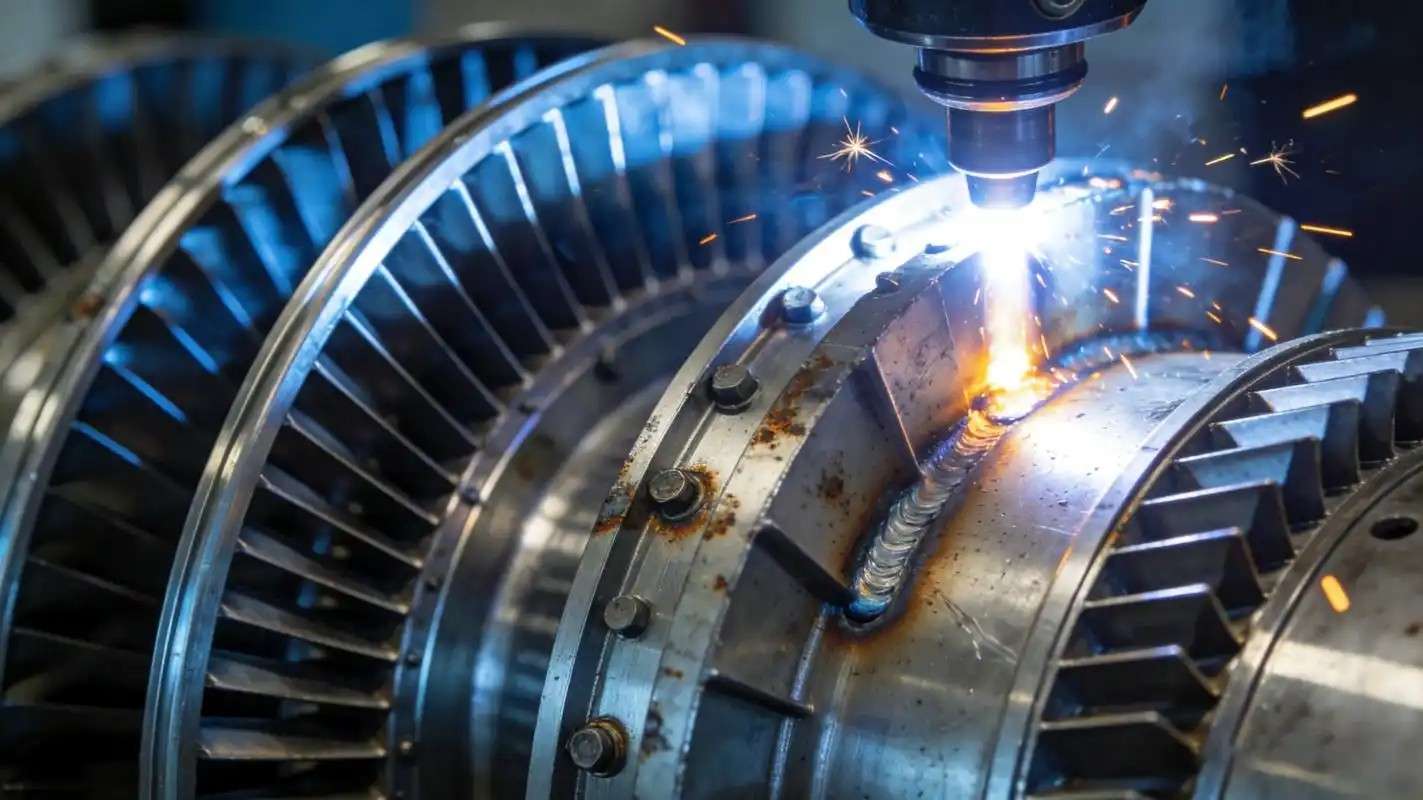
Turbo laser welding
How to Choose a Laser Welding Machine for Aerospace
Machine selection should start with the workpiece rather than the laser power.
Step 1: Define the Material
Identify the exact material and grade.For example:
- Aluminum alloy
- Titanium alloy
- Stainless steel
- Nickel alloy
- Thermoplastic
- CFRTP
Different materials require different laser parameters and process conditions.
Step 2: Define the Joint
Determine whether the application requires:
- Butt welding
- Lap welding
- Fillet welding
- Circumferential welding
- Tube-to-flange welding
- Tube-to-plate welding
- Corner welding
- Complex 3D welding
Step 3: Determine the Required Movement
Simple flat or 2D welds may only require 3-axis movement.
Rotational components may benefit from 4-axis movement.
Components requiring changing welding-head orientation may need 5-axis movement.
Complex components with two independent rotary requirements may benefit from 6-axis CNC movement.
Large irregular structures may be better suited to a 6-axis robot system.
Thermoplastic components may require a dedicated plastic laser welding machine and customized fixture.
Step 4: Determine the Workpiece Size
Workpiece dimensions affect whether a conventional CNC platform, large-format CNC machine, or robotic system is appropriate.Large aerospace structures may require a much larger working envelope than small precision components.
Step 5: Consider Fixtures
Fixtures are particularly important for repeatable aerospace welding.The fixture needs to:
- Position the components accurately
- Maintain joint alignment
- Control movement during welding
- Provide adequate support
- Avoid unnecessary deformation
For plastic laser welding, fixture design can be even more important because the clamping and positioning conditions directly affect the welding interface.
Step 6: Validate the Process
Before final machine selection, sample testing should be considered.The actual material, thickness, joint design, laser source, welding head, shielding gas, fixture, welding speed, and other process parameters should be evaluated using representative samples.
For critical aerospace applications, machine selection should be part of a broader process-development and qualification program.
The Future of Laser Welding in Aerospace
Aerospace manufacturing continues to move toward lightweight materials, composite structures, automation, and more intelligent production systems.Several areas are attracting continued development:
Lightweight Metal Structures
Aluminum, titanium, and other lightweight alloys remain important for aerospace structures.
Laser welding can support the development of lightweight welded components where the process is technically and economically suitable.
Thermoplastic Composite Welding
Thermoplastic composites offer opportunities for lightweight structures and potentially faster joining processes.
Laser transmission welding and other laser-based joining technologies are being investigated for fiber-reinforced thermoplastics and aerospace structures.
Plastic-Metal Hybrid Structures
Combining plastics, composites, and metals can help engineers optimize weight and mechanical performance.
Laser-based surface structuring and joining technologies are being developed for these hybrid materials.
Robotic and Multi-Axis Welding
As components become more complex, multi-axis CNC and robotic systems can provide more flexible access to three-dimensional welding paths.
Future systems may combine:
- Robot movement
- CNC positioners
- Vision systems
- Seam tracking
- Process monitoring
- Automatic wire feeding
- Digital production management
- Adaptive welding control
AI-Assisted Welding
Artificial intelligence may increasingly be used for weld-seam recognition, parameter optimization, defect detection, and adaptive process control.
However, aerospace applications require much more than simply adding AI to a machine. Any intelligent welding system still needs to satisfy the material, process, inspection, qualification, and traceability requirements of the actual application.
Why Choose ZS Machinery for Aerospace Laser Welding?
Aerospace welding projects can range from small precision components to complex multi-axis structures. There is therefore no single laser welding machine that fits every application.ZS Machinery provides different configurations according to the component and welding process, including:
- 3 Axis CNC Laser Welding Machines
- 4 Axis CNC Laser Welding Machines
- 5 Axis CNC Laser Welding Machines
- 6 Axis CNC Laser Welding Machines
- 6 Axis Robot Laser Welding Machines
- Plastic Laser Welding Machines
- Customized laser welding systems
Our approach starts with the workpiece.
We evaluate the material, thickness, joint design, component dimensions, welding direction, production volume, fixture requirements, and required automation before recommending a machine configuration.
For complex applications, sample testing can help determine whether a conventional CNC system, multi-axis machine, robotic system, or dedicated plastic laser welding solution is appropriate.
Conclusion
Laser welding offers a precise and highly controllable joining method for selected aerospace applications, including lightweight metal structures, tubes, brackets, tanks, heat exchangers, precision components, and other assemblies.
The technology is also expanding into thermoplastic composites and plastic-metal hybrid structures as aerospace manufacturers continue to explore lightweight materials and new joining methods.
For aerospace applications, however, machine capability is only one part of the process. Material compatibility, joint design, fixtures, welding parameters, inspection, testing, and process qualification must all be considered.
If you have an aerospace component that requires laser welding, ZS Machinery can evaluate the application and recommend a suitable CNC, robotic, or plastic laser welding configuration based on the actual workpiece.