
CNC Laser Welding in Sheet Metal Fabrication
Sheet metal fabrication covers a wide range of products, from small metal brackets and electrical boxes to large equipment housings, control cabinets, and industrial frames. These products often require multiple welding joints, consistent weld quality, and efficient production for repeated orders.
CNC laser welding is increasingly suitable for sheet metal fabrication because it provides accurate, repeatable, and highly controllable welding. For smaller sheet metal parts, a CNC laser welding machine with a working table can provide an efficient solution. For larger or more complex fabrications, a robotic laser welding system can provide a much larger working envelope and greater flexibility.
This makes laser welding suitable for both small and large sheet metal components, especially for manufacturers producing the same or similar products in batches.
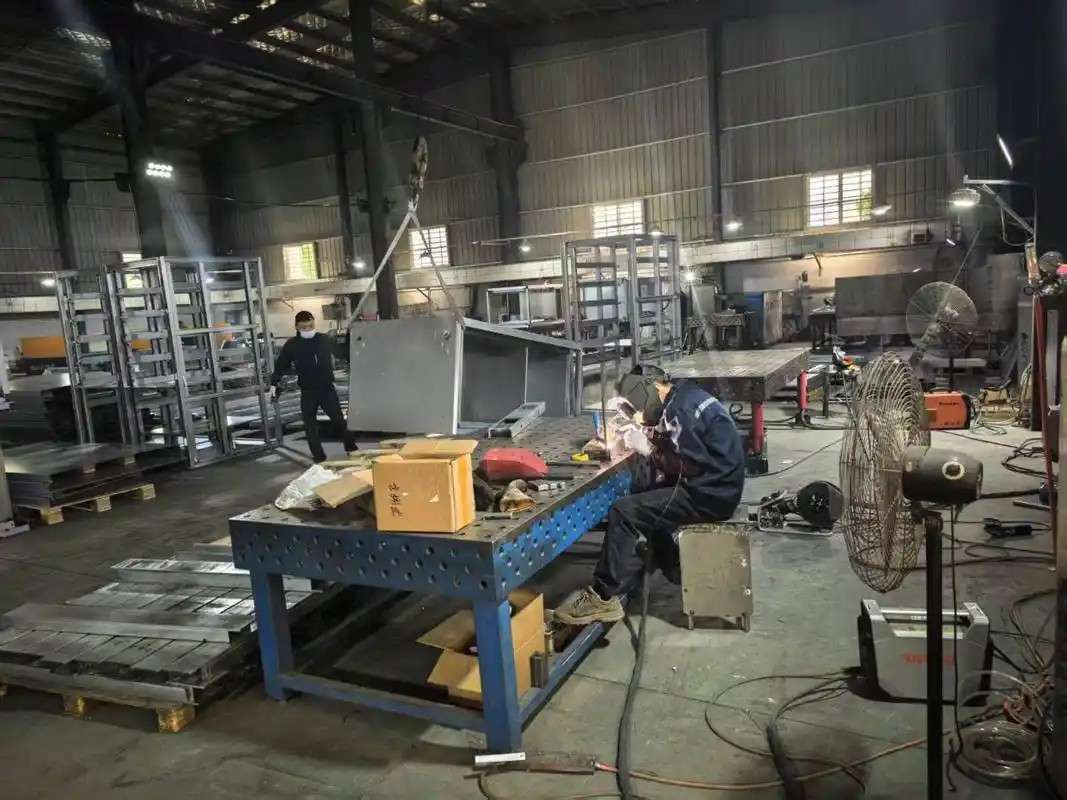
Sheet metal processing industry
Why Use CNC Laser Welding for Sheet Metal Fabrication?
Traditional welding methods can be used for many sheet metal products, but laser welding offers several advantages when manufacturers need controlled heat input, consistent welds, and repeatable production.
The concentrated laser beam can create a narrow and precise weld with a relatively small heat-affected area. This is particularly useful for sheet metal parts where excessive heat can cause deformation or affect the appearance of the finished product.
For batch production, CNC controlled welding also allows the welding path and process parameters to be programmed and repeated from one workpiece to the next.Key advantages include:
- Precise and repeatable welding
- Low and controlled heat input
- Reduced risk of sheet metal deformation
- Narrow and clean weld seams
- High welding consistency
- Suitable for automated production
- Easy integration with fixtures and positioning systems
- Suitable for batch and repetitive production
The actual welding result still depends on material, thickness, joint design, fit-up, laser power, welding speed, shielding gas, and other process parameters.
Sheet Metal Products Suitable for Laser Welding
Sheet metal fabrication covers many different products and components. Laser welding can be used for both simple and complex fabricated structures when the joint design and material are suitable.
Sheet Metal Enclosures
Sheet metal enclosures are commonly used to protect electrical, electronic, and industrial components.
Laser welding can be used for corners, seams, panels, mounting structures, and other joints where a controlled and consistent weld is required.
Electrical Enclosures
Electrical enclosures require accurate fabrication and consistent welding because the enclosure must provide adequate structural strength and protect internal electrical components.
For repeated production, CNC laser welding can help maintain consistent welding positions and reduce variations between individual enclosures.
Control Cabinets
Control cabinets are widely used in industrial automation, electrical systems, machinery, and power equipment.
Laser welding can be applied to cabinet frames, panels, doors, internal structures, and other sheet metal components.
Server Racks
Server racks and network cabinets are typically assembled from multiple sheet metal panels, frames, brackets, and structural components.
For manufacturers producing large quantities of similar cabinets, automated laser welding can help improve production consistency.
Metal Cabinets
Metal cabinets are used for industrial equipment, electrical systems, storage, machinery, and other applications.
Laser welding is suitable for welding cabinet panels, corners, frames, doors, and internal structures.
Metal Boxes
Small and medium-sized metal boxes are another common sheet metal fabrication product.
For these relatively compact workpieces, a CNC laser welding machine with a working table and suitable fixture can provide an efficient production solution.
Metal Frames and Brackets
Metal frames and brackets often contain multiple short welding seams.
CNC welding allows the welding path to be programmed, making it suitable for repeated production of the same components.
Sheet Metal Panels
Panels may be used as machine covers, equipment panels, electrical panels, and structural components.
Laser welding can be used where panels need to be joined to frames, brackets, or other sheet metal components.
Machine Covers
Machine covers and protective housings are widely used in industrial machinery.
Laser welding can provide controlled welding for corners, seams, frames, and other joints while helping reduce unnecessary thermal deformation.
Equipment Housings
Industrial equipment often requires customized sheet metal housings with multiple panels and internal structures.
Depending on the size and geometry of the housing, CNC or robotic laser welding can be selected according to the production requirements.
Custom Metal Fabrications
Custom sheet metal fabrication covers a wide range of products made according to customer drawings or specific requirements.
Laser welding can be integrated into customized production lines for products with repeatable structures and batch production requirements.
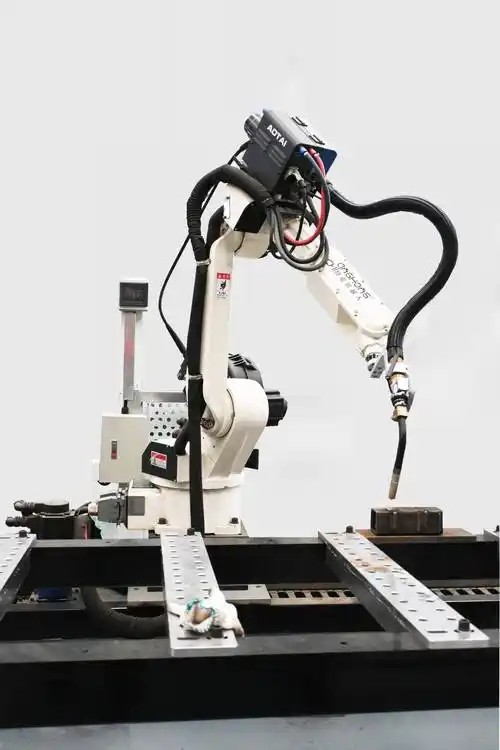
Robot welding sheet metal cabinet
CNC Laser Welding for Small Sheet Metal Parts
For small and medium-sized sheet metal products, a CNC Laser Welding Machine with a working table is often a practical solution.The workpiece can be positioned on the welding table using a customized fixture. The CNC system then controls the welding head according to the programmed welding path.This setup is particularly suitable for products such as:
- Metal boxes
- Small electrical enclosures
- Metal brackets
- Sheet metal frames
- Small equipment housings
- Panels
- Covers
- Metal components
For batch production, the same welding program can be reused after the workpiece is correctly positioned, helping reduce operator-dependent variations.
Robotic Laser Welding for Large Sheet Metal Fabrication
Large sheet metal products can be more difficult to process on a conventional fixed CNC platform because the working area and movement range may become limiting factors.For these applications, robotic laser welding can provide greater flexibility.
A 6-axis industrial robot can move the welding head around larger workpieces and approach welding joints from different directions. A positioner can also rotate or tilt the workpiece when required.This makes robotic laser welding suitable for larger products such as:
- Large equipment housings
- Large electrical cabinets
- Industrial frames
- Machine structures
- Large sheet metal enclosures
- Equipment panels
- Customized metal fabrications
The robot’s working envelope can be selected according to the size and geometry of the workpiece.
CNC Laser Welding vs. Robotic Laser Welding for Sheet Metal
Both CNC and robotic systems can be used for sheet metal fabrication, but they are suitable for different production requirements.
| Requirement | CNC Laser Welding | Robotic Laser Welding |
|---|---|---|
| Small sheet metal parts | Excellent | Suitable |
| Medium-sized parts | Excellent | Suitable |
| Large workpieces | Depends on machine size | Excellent |
| Repetitive production | Excellent | Excellent |
| Complex welding angles | Depends on axis configuration | Excellent |
| Large working envelope | Limited by machine design | Larger and flexible |
| Fixture integration | Yes | Yes |
| Automated production | Yes | Yes |
| Customized production | Yes | Yes |
For relatively compact products, a CNC laser welding machine can provide a straightforward and efficient solution.
While for large, complex, or multi-angle sheet metal structures, a robotic laser welding system may provide greater flexibility.
CNC Laser Welding for Batch Production
One of the important advantages of CNC and robotic laser welding is their suitability for batch production.
Many sheet metal manufacturers produce hundreds or thousands of similar products rather than completely different products every time. Once the fixture, welding program, and process parameters have been established, the same process can be repeated for subsequent workpieces.A typical production process can be:
Sheet Metal Cutting → Bending/Forming → Positioning & Fixturing → CNC/Robotic Laser Welding → Inspection → Finishing
For larger production volumes, additional automation can be integrated, such as:
- Automatic loading and unloading
- Welding positioners
- Rotary fixtures
- Customized fixtures
- Vision systems
- Seam tracking
- Material handling systems
The appropriate level of automation depends on production volume, product geometry, welding complexity, and the required cycle time.
How to Choose a Laser Welding Machine for Sheet Metal
There is no single laser welding machine suitable for every sheet metal fabrication project.The machine should be selected according to the actual workpiece and production requirements.Important factors include:
Workpiece Size
Small metal boxes and brackets can generally be handled on a CNC welding platform, while large cabinets and equipment housings may require a larger working area or robotic system.
Material and Thickness
Common sheet metal materials include stainless steel, carbon steel, galvanized steel, aluminum, and other alloys.
Material type and thickness directly affect laser power, welding speed, joint design, shielding gas, and process parameters.
Welding Joint
The joint may be a corner joint, lap joint, butt joint, or other customized configuration.
The joint design should be evaluated before selecting the welding head, laser power, and fixture.
Production Volume
For prototype or low-volume production, a flexible CNC system may be sufficient.
For stable high-volume production, a customized fixture and automated or robotic welding system can improve production consistency and efficiency.
Product Geometry
Simple flat components may require only a basic CNC movement system.
Products with multiple welding directions, large dimensions, or complex structures may benefit from additional rotary axes, positioners, or robotic arms.
CNC Laser Welding Machine for Sheet Metal
Sheet metal fabrication often involves corners, edges, frames, and multi-angle joints rather than simple flat welding. For this reason, 4-axis CNC laser welding is a practical starting point for many sheet metal applications.Depending on the workpiece size, welding angles, and production requirements, ZS Machinery offers 4-axis, 5-axis, and 6-axis CNC laser welding machines, as well as robotic laser welding systems.
4 Axis CNC Laser Welding Machine
A 4 Axis CNC Laser Welding Machine is suitable for small and medium-sized sheet metal products that require rotary positioning in addition to XYZ movement.The rotary axis can rotate the workpiece during welding, making it suitable for products with circular or multi-sided structures.
Typical applications:
- Small metal boxes
- Sheet metal enclosures
- Brackets
- Small cabinets
- Cylindrical or round components
- Pipe and tube assemblies
5 Axis CNC Laser Welding Machine
A 5 Axis CNC Laser Welding Machine adds a welding-head swing axis to the XYZ and rotary axes. This allows the welding head to change its orientation while the workpiece is being positioned.It is particularly suitable for sheet metal products with multiple welding angles and more complex joint geometries.
Typical applications:
- Electrical cabinets
- Control cabinets
- Metal cabinets
- Equipment housings
- Machine covers
- Sheet metal frames
- Complex custom fabrications
For many customized sheet metal products, 5-axis CNC laser welding is a flexible solution because both the workpiece and welding-head orientation can be controlled.
6 Axis CNC Laser Welding Machine
A 6 Axis CNC Laser Welding Machine provides additional rotary movement, giving the system greater flexibility when welding products with multiple surfaces, curved structures, or complex welding positions.It is suitable for sheet metal components that require welding from different directions and for products with more complicated three-dimensional structures.
Typical applications:
- Complex equipment housings
- Large and irregular sheet metal structures
- Multi-angle metal frames
- Customized industrial components
- Parts requiring multiple welding orientations
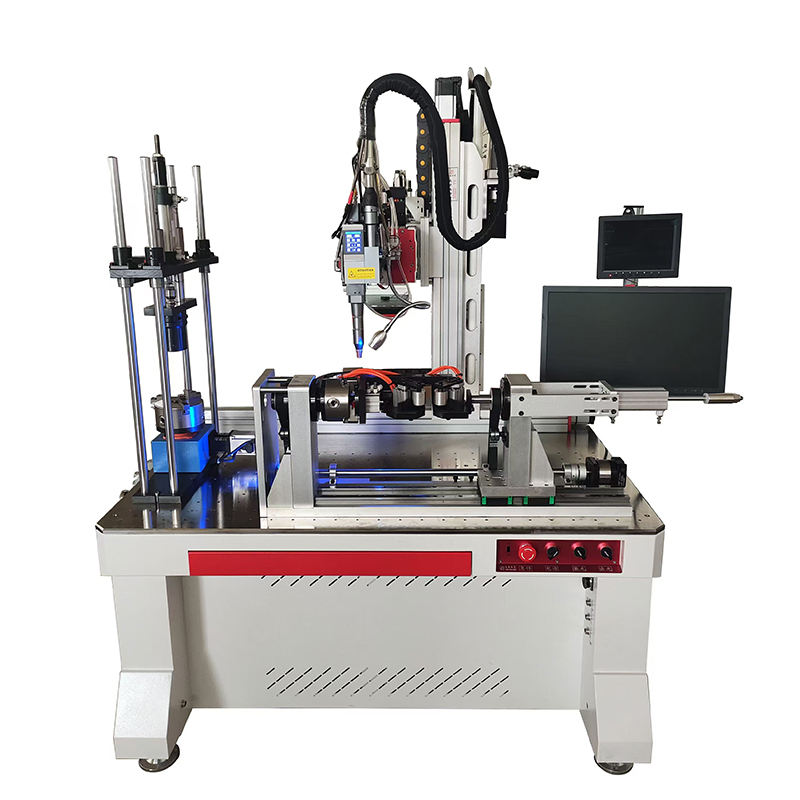
6 axis cnc laser welding mahcine
Robotic Laser Welding Machine
For large sheet metal products or high-volume production, a robotic laser welding system can provide a larger working envelope and greater flexibility than a fixed CNC platform.
A 6-axis industrial robot can move the welding head around the workpiece and reach welding joints from different directions. A welding positioner can also be integrated to rotate or tilt the workpiece when required.
Typical applications:
- Large electrical cabinets
- Large equipment housings
- Industrial frames
- Machine structures
- Large sheet metal enclosures
- Heavy or oversized fabricated components
- High-volume sheet metal production
Choosing the Right Laser Welding System
The suitable configuration depends mainly on workpiece size, welding angles, joint geometry, production volume, and automation requirements.
As a general guide:
4 Axis → Small and medium-sized products with rotary positioning requirements
5 Axis → Multi-angle sheet metal products and more complex welding joints
6 Axis → Complex three-dimensional structures requiring greater positioning flexibility
Robot → Large workpieces, complex structures, and automated batch production
For a customized sheet metal project, ZS Machinery can evaluate the product structure and recommend the appropriate CNC or robotic laser welding configuration.You can click here to know more about difference.
Conclusion
Sheet metal fabrication is one of the most suitable application areas for CNC and robotic laser welding. From small metal boxes and brackets to large electrical cabinets, equipment housings, and industrial frames, laser welding can be adapted to different workpiece sizes and production requirements.
For smaller products, a CNC Laser Welding Machine provides a controlled and repeatable welding platform. For larger or more complex workpieces, robotic laser welding offers a larger working envelope and greater flexibility.
For manufacturers producing sheet metal products in batches, the combination of laser welding, customized fixtures, CNC control, and robotic automation can provide a scalable production solution.
Contact ZS Machinery
Looking for a Laser Welding Machine for Sheet Metal?
Send us your product drawings, material, thickness, dimensions, and production requirements. ZS Machinery can help evaluate the suitable CNC or robotic laser welding solution for your application.