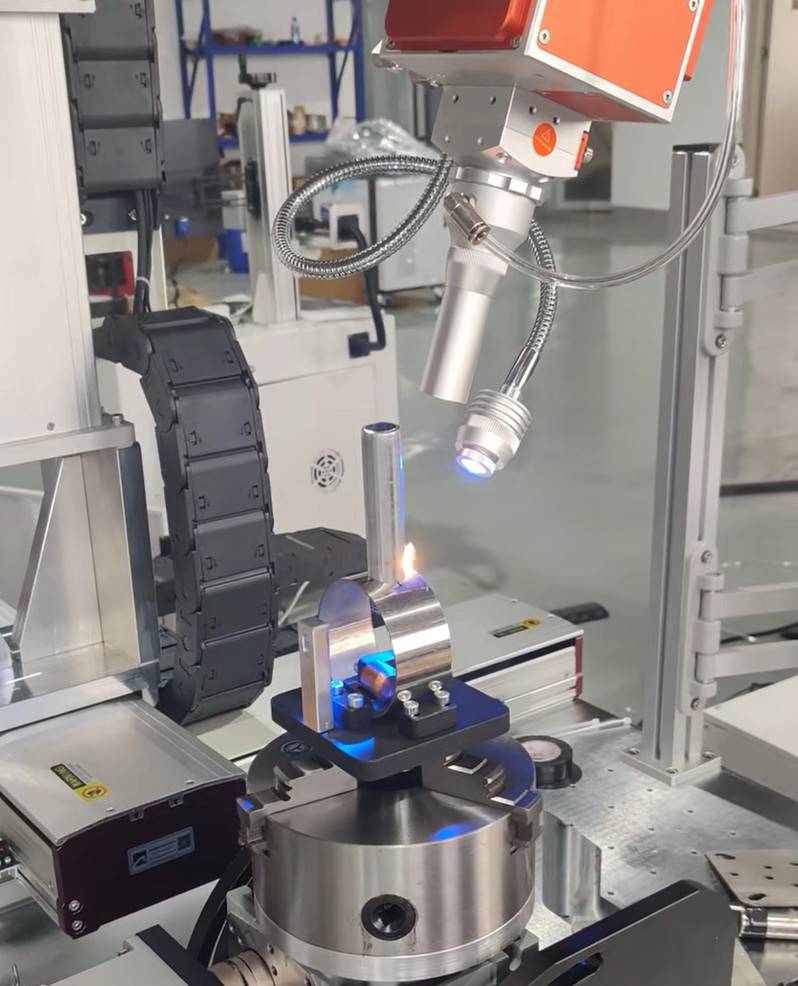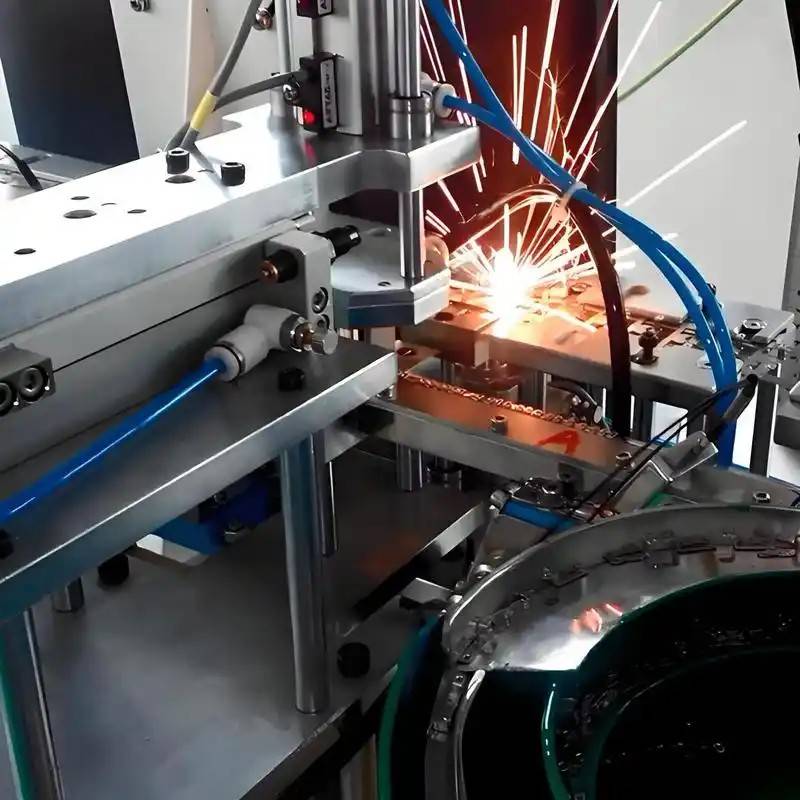
Robotic Welding: Complete Guide to Automated Welding Systems
Robotic welding is an automated welding process in which a robot controls the movement of a welding torch or laser welding head along a programmed welding path. Unlike manual welding, where an operator continuously controls the welding tool, robotic welding uses a combination of robotics, welding equipment, fixtures, positioners, control systems, and software to perform repeatable welding operations.
Today, most robotic welding systems are based on industrial robotic arms, typically with multiple controlled axes, rather than humanoid robots. Although embodied intelligence and humanoid robotics are developing rapidly, industrial welding does not require a human-shaped robot for most production tasks. A dedicated robotic arm can provide the reach, positioning flexibility, payload capacity, and repeatability required for industrial welding more efficiently.
A complete robotic welding system can range from a robot equipped with a welding torch to a fully integrated robotic welding cell with a laser source, welding head, positioner, fixture, safety enclosure, sensors, control system, and automated loading and unloading.
This guide explains how robotic welding works, the main components of an automated welding system, different types of robotic welding, applications, and how to choose a suitable robotic welding solution.
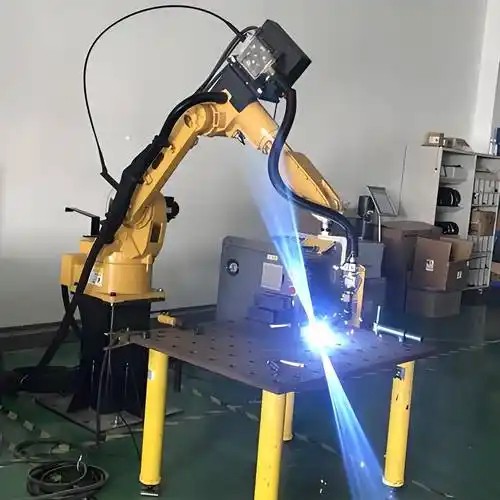
Robotic Welding Process
What Is Robotic Welding?
Robotic welding is the use of a programmable robotic system to perform welding operations automatically.
The robot moves the welding tool along a predefined path while the welding system controls the welding process. Depending on the application, the robot may carry the welding torch or laser welding head, while a separate positioner rotates or tilts the workpiece.
A typical robotic welding system can include:
Industrial Robot + Welding Source + Welding Torch or Laser Welding Head + Fixture + Positioner + Controller + Safety System
For laser welding, the system may be configured as:
Multi-Axis Robot + Laser Source + Laser Welding Head + Welding Fixture + Positioner + Control System
This is why robotic welding should not be understood as simply putting a welding gun onto a robot. The robot is only one part of the complete automated welding system.
Modern robotic laser welding cells from major industrial suppliers can combine 6-axis robots with laser sources, processing heads, tooling, part handling, and positioners as a complete production system.
Robotic Welding and Humanoid Robots: What Is the Difference?
The rapid development of embodied intelligence and humanoid robots has attracted significant attention in recent years. This naturally raises a question:
Will humanoid robots replace traditional welding robots?
For industrial welding today, these are two different concepts.
Most production robotic welding systems use dedicated industrial robotic arms, not humanoid robots.
A typical industrial welding robot is designed specifically for repetitive motion, high-speed positioning, controlled payloads, and integration with welding equipment. A 6-axis robotic arm can move the welding tool around a workpiece and change its orientation according to the programmed welding path.
A humanoid robot, in contrast, is designed around a human-like body structure and broader physical interaction capabilities. Its potential applications may include working in environments designed for humans, handling different tools, and performing a wider range of tasks.However, welding production does not necessarily require a human-shaped body.
For a dedicated welding application, manufacturers can use:
- 6-axis industrial robots
- Collaborative robots
- Gantry robots
- Customized robotic systems
- Positioners and rotary tables
- Automated welding cells
The development of embodied intelligence may make future robots more capable of understanding their environment, learning tasks, and adapting to changes. However, today’s industrial robotic welding systems are still mainly based on dedicated robotic arms and automated welding cells.
In other words:Robotic welding does not mean humanoid robot welding.
The key objective is not to reproduce the human body, but to provide controlled, repeatable, and programmable movement for the welding process.
How Does Robotic Welding Work?
The basic robotic welding process can be divided into several stages.
1. Workpiece Loading
The workpiece is loaded into the welding cell and positioned using a fixture, worktable, pallet, or positioner.
2. Workpiece Positioning
The fixture holds the workpiece in the correct location.
For complex components, a rotary or multi-axis positioner may rotate or tilt the workpiece during welding.
3. Robot Positioning
The robot moves the welding torch or laser welding head to the starting position.A 6-axis robot can approach the workpiece from different directions and orient the welding tool according to the joint geometry.
4. Welding Path Execution
The robot follows a programmed welding path.Depending on the process, the welding system controls parameters such as:
- Laser power
- Welding speed
- Wire feeding
- Shielding gas
- Welding current
- Voltage
- Beam wobble
- Welding head movement
5. Positioner Movement
If a positioner is included, the workpiece may rotate or tilt during welding.This allows the robot and workpiece to work together rather than requiring the robot to perform every movement by itself.
6. Welding Completion
After completing the programmed welding path, the robot returns to its designated position and the finished workpiece can be unloaded.The process can then be repeated for the next workpiece.
Main Components of a Robotic Welding System
A robotic welding system is a combination of several components rather than a single machine.
Industrial Robot
The robot provides the primary movement of the welding tool.A 6-axis industrial robot is commonly used because it provides multiple degrees of freedom for positioning and orienting the welding torch or laser welding head.Robot selection depends on:
- Robot reach
- Payload
- Repeatability
- Working envelope
- Welding path
- Workpiece dimensions
- Positioner configuration
Welding Source
The welding source provides the energy required for the welding process.Depending on the application, this can include:
- Laser source
- MIG/MAG power source
- TIG power source
- Other specialized welding sources
For robotic laser welding, a fiber laser is typically connected to the laser processing head through a beam delivery system.
Welding Torch or Laser Welding Head
The welding tool is mounted to the robot wrist.
For arc welding, this may be a MIG/MAG or TIG torch.
For laser welding, the robot carries a laser welding head or processing head.
The tool must be selected according to the material, joint design, laser power, welding speed, and required process configuration.
Welding Fixture
The fixture holds the workpiece in the correct position.Fixture design is particularly important in robotic welding because the robot follows a programmed path based on the expected workpiece position.Changes in workpiece position can affect the welding path.A suitable fixture can provide:
- Accurate positioning
- Stable clamping
- Repeatable loading
- Controlled workpiece location
- Support for different welding orientations
Welding Positioner
A positioner rotates or tilts the workpiece during welding.For example, a 2-axis positioner can provide:
- 360° rotation
- Workpiece tilting
- Multi-angle positioning
This can reduce the amount of movement required from the robot and provide better access to different welding surfaces.
Positioners can also include rotary tables, headstock/tailstock systems, tilt-rotate tables, and other workpiece handling mechanisms.Industrial robotic welding platforms commonly integrate positioners and turntables as part of the overall welding cell.
Robot Controller
The controller coordinates robot movement and communicates with other parts of the welding system.It manages the programmed robot path and can coordinate signals between:
- Robot
- Welding source
- Positioner
- Sensors
- Fixtures
- Safety system
- Loading and unloading equipment
Safety System
Industrial robotic welding cells normally require appropriate safety measures according to the system design and applicable regulations.A robotic welding cell may include:
- Protective enclosure
- Safety doors
- Interlocks
- Emergency stops
- Safety sensors
- Laser safety protection for laser welding systems
The safety configuration depends on the welding process and cell design.
Types of Robotic Welding
Robotic welding is not a single welding process. Different welding technologies can be combined with robotic systems.
Robotic MIG/MAG Welding
Robotic MIG/MAG welding is widely used for fabricated metal components and structural assemblies.The robot controls the welding torch while the welding power source controls the arc and wire feeding process.Typical applications include:
- Steel structures
- Automotive components
- Machinery
- Metal frames
- Sheet metal assemblies
Robotic TIG Welding
Robotic TIG welding can be used where controlled arc welding and precise weld appearance are required.It may be suitable for certain stainless steel, aluminum, and other metal components depending on the joint and production requirements.
Robotic Laser Welding
Robotic laser welding combines a laser welding system with a robotic arm.The robot provides flexible movement while the laser provides concentrated heat input.A robotic laser welding system can be suitable for complex 3D components, multi-angle welding, large workpieces, and applications requiring flexible tool orientation.
Collaborative Robot Welding
A collaborative robot, or cobot, can be used for certain welding applications where human-robot collaboration and simpler programming are important.
However, cobots and industrial robots are not interchangeable in every application. Robot payload, speed, working envelope, safety requirements, and production volume should all be considered.
What Is a Robotic Welding Cell?
A robotic welding cell is a complete automated welding workstation that integrates the robot with the equipment required to perform the welding process.A robotic welding cell may include:
Robot
↓
Welding Source
↓
Welding Torch / Laser Welding Head
↓
Fixture
↓
Positioner
↓
Control System
↓
Safety Enclosure
Additional equipment may include:
- Wire feeder
- Vision system
- Seam tracking
- Automatic loading
- Automatic unloading
- Conveyor
- Part inspection
- Fume extraction
- Process monitoring
The exact configuration depends on the application.
For laser welding, a robotic laser welding cell can integrate a 6-axis robot, laser source, processing head, tooling, positioner and material handling equipment into one production system.
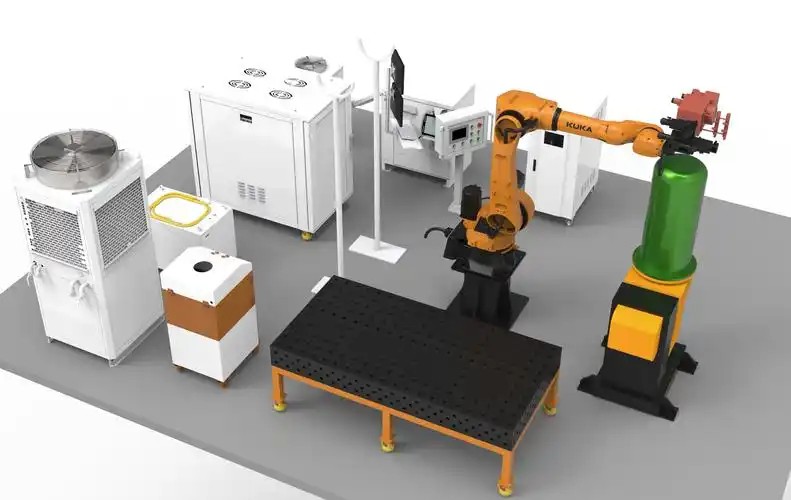
Robotic laser welding cells
Robotic Welding vs Manual Welding
The main difference between robotic and manual welding is how the welding movement and process are controlled.
| Feature | Manual Welding | Robotic Welding |
|---|---|---|
| Welding Tool Movement | Operator controlled | Robot controlled |
| Welding Path | Operator dependent | Programmed |
| Repeatability | Depends on operator | Highly repeatable |
| Production Volume | Flexible for low volume | Suitable for repetitive production |
| Complex Movement | Depends on operator skill | Programmable multi-axis movement |
| Positioner Integration | Optional | Common |
| Programming | Not required | Required |
| Initial Investment | Lower | Higher |
| Flexibility | High for constantly changing jobs | High for repeatable automated jobs |
Robotic welding is particularly useful when the same or similar welding operations need to be repeated many times.For highly variable, low-volume work, manual or semi-automatic welding may remain practical.The right solution depends on production volume, workpiece geometry, labor availability, welding process, and automation requirements.
Robotic Welding vs CNC Welding
Robotic welding and CNC welding machines can both automate welding, but their mechanical structures are different.A CNC welding machine typically uses defined linear and rotary axes within a machine structure.A robotic welding system uses a robotic arm with multiple joints.
| Feature | CNC Welding Machine | Robotic Welding |
|---|---|---|
| Motion Structure | Linear and rotary axes | Multi-joint robotic arm |
| Working Envelope | Defined by machine travel | Defined by robot reach |
| Tool Orientation | Depends on machine axes | Highly flexible |
| Complex 3D Parts | Depends on configuration | Suitable for complex paths |
| Positioner Integration | Available | Common |
| Programming | CNC programming | Robot programming |
| Large Workpieces | Depends on machine design | Can be configured with suitable robot reach |
| Best Application | Defined working area | Multi-angle and complex 3D welding |
Neither system is automatically suitable for every welding application.
The choice should be based on the workpiece dimensions, welding geometry, working envelope, required tool orientation, production volume and automation requirements.
Advantages of Robotic Welding
Repeatable Welding Movement
Once a suitable welding program has been developed, the robot can repeat the programmed path for similar workpieces.This can help reduce variation caused by manual movement.
Multi-Axis Flexibility
A 6-axis robot can approach the workpiece from different directions and orient the welding tool for complex welding paths.
Suitable for Repetitive Production
Robotic welding can be valuable when manufacturers repeatedly weld similar parts.
Integration with Positioners
The robot can work together with rotary tables, tilt-rotate positioners and other workpiece handling equipment.
Integration with Automated Production
Robotic welding cells can be connected with loading, unloading, conveying, inspection, and other production processes.
Reduced Manual Welding Work
The robot can perform programmed welding operations while operators focus on loading, unloading, supervision, quality control, programming, and other production tasks.
Limitations of Robotic Welding
Robotic welding also has limitations that should be considered before automation.
Higher Initial Investment
A complete robotic welding cell normally requires more equipment than a manual welding workstation.The system may include the robot, welding equipment, fixture, positioner, safety system and control system.
Programming
The robot needs a suitable welding program.The complexity of programming depends on the workpiece geometry and welding path.
Fixture Requirements
Robotic welding requires consistent workpiece positioning.Poor fixture design or excessive workpiece variation can make automated welding more difficult.
Process Development
The robot does not automatically guarantee a good weld.The welding process still requires appropriate parameters, joint design, material preparation, shielding gas, laser or arc settings, and testing.
Not Every Product Needs a Robot
For simple one-off welding jobs, manual or handheld welding may be more practical.Robotic welding becomes more attractive when repeatability, production volume, complex movement, or automation requirements justify the additional system investment.
Robotic Laser Welding Applications
Robotic laser welding can be configured for many industrial applications.
Automotive
Applications can include:
- Automotive structural components
- Brackets
- Battery components
- Motor components
- Exhaust components
- Sheet metal assemblies
- Aluminum components
EV and Battery
Robotic laser welding can be used for certain battery components and assemblies, including cylindrical, prismatic and pouch battery-related applications depending on the process and system configuration.
Industrial laser system suppliers currently offer robotic laser systems for battery welding applications using 6-axis robots and customized tooling.
Sheet Metal Fabrication
Robotic welding can be used for:
- Cabinets
- Enclosures
- Frames
- Machinery components
- Sheet metal assemblies
Industrial Equipment
Complex machinery components can benefit from multi-axis robot movement when welding seams are located on different surfaces.
Pipes and Cylindrical Components
Robotic systems can be combined with rotary positioners to weld pipes, cylindrical housings, shafts, flanges, and other round components.
Kitchen and Food Equipment
Stainless steel equipment, cabinets, frames, tanks, and other fabricated components can be automated when production volume and product consistency justify robotic welding.
Medical and Precision Equipment
Certain precision metal components and equipment housings can be processed using automated welding systems when the required material, joint design, dimensional tolerances, and process requirements are suitable.
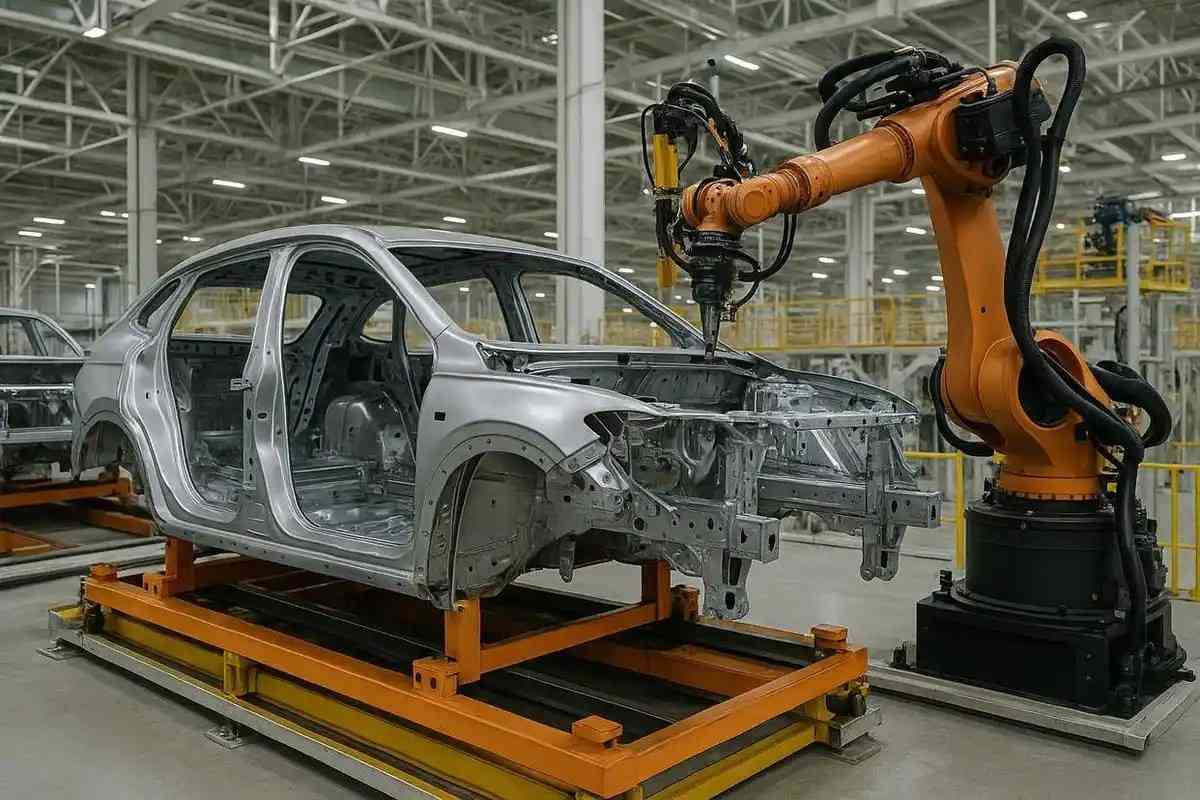
Robot laser welding for automotive Body-in-White
Robotic Welding with Vision and Seam Tracking
As robotic welding develops, sensing technology is becoming increasingly important.A conventional robotic system generally follows a predefined program.However, real-world workpieces are not always identical.Variations can occur because of:
- Workpiece tolerances
- Fixture tolerances
- Thermal deformation
- Part positioning
- Joint gap variation
Vision systems and seam tracking sensors can help detect changes in the workpiece or weld seam and provide information for adjusting the welding path.
Modern automated welding systems can integrate sensors and process monitoring with robotic movement.This direction is important for the future of robotic welding because it moves automation from simple repeatable movement toward more adaptive production.
AI and the Future of Robotic Welding
Artificial intelligence is beginning to influence robotic welding in areas such as programming, process monitoring, sensing, inspection, and production optimization.The long-term direction is not simply to make a robot move faster.Instead, the development is moving toward systems that can better understand:
- What the workpiece looks like
- Where the welding seam is located
- How the workpiece is positioned
- Whether the welding process is stable
- Whether the weld meets the required quality
- How the welding program should be adjusted
This is where the development of embodied intelligence becomes relevant.
Future robotic systems may combine robots, vision, sensors, AI software and process knowledge to perform more adaptive manufacturing tasks.However, this does not mean that humanoid robots will immediately replace industrial welding robots.
For welding production, the practical direction is likely to include different forms of automation:
Industrial Robot → Cobot → Vision-Guided Robot → Adaptive Robotic Welding → AI-Assisted Welding
Humanoid robots may eventually participate in manufacturing environments designed around human workers, but dedicated industrial robot arms remain highly suitable for specialized welding tasks because they are designed around specific production requirements.
How to Choose a Robotic Welding System?
Choosing a robotic welding system should begin with the workpiece rather than the robot itself.
1. Workpiece Size
Determine the overall dimensions of the workpiece.The robot reach and working envelope must be sufficient to access all required welding areas.
2. Workpiece Weight
The robot payload must be suitable for the welding torch, laser welding head, cables, and other equipment mounted on the robot.If the workpiece is moved by a positioner, the positioner’s load capacity must also be considered.
3. Welding Geometry
Identify whether the welding seams are:
- Straight
- Circular
- Curved
- Multi-angle
- 3D
- Internal
- External
The welding geometry directly affects robot configuration and positioner requirements.
4. Welding Process
Determine whether the application requires:
- MIG/MAG
- TIG
- Laser welding
- Other specialized welding processes
The welding source and robot configuration should be designed around the selected process.
5. Positioner Requirements
Ask whether the workpiece needs to rotate or tilt during welding.A positioner can significantly expand the practical welding range of a robotic system.
6. Fixture Requirements
The fixture should position the workpiece consistently and provide sufficient support during welding.
7. Production Volume
Robotic welding is generally more attractive when the same or similar welding operations are repeated regularly.For highly customized one-off work, a manual or flexible semi-automatic solution may be more appropriate.
8. Automation Level
Consider whether you need:
- Manual loading
- Automatic loading
- Automatic unloading
- Conveyor integration
- Vision guidance
- Seam tracking
- Automatic inspection
- Production data collection
The automation level can be increased according to production requirements.
Robotic Welding System from ZS Machinery
ZS Machinery provides robotic welding solutions for manufacturers looking to automate repetitive and multi-angle welding operations.Depending on the application, the system can be configured with:
- Multi-axis industrial robot
- Fiber optic or semiconductor laser source
- Laser welding head
- Welding fixture
- Rotary or tilt-rotate positioner
- Control system
- Safety enclosure
- Wire feeder
- Optional vision or sensing systems
For larger or more complex workpieces, the robot’s working envelope can provide greater flexibility than a conventional XYZ welding platform.
The final configuration should be determined according to the workpiece dimensions, weight, welding path, material, joint design, production volume, and required automation level.
Conclusion
Robotic welding is a complete automation system, not simply a robot carrying a welding torch.
A practical robotic welding solution combines the robot with the welding source, welding head, fixture, positioner, control system, safety equipment, and other components required for the specific application.
Today, most industrial robotic welding systems are based on industrial robotic arms, especially 6-axis robots, rather than humanoid robots. As embodied intelligence, machine vision, AI-assisted programming, and adaptive process control continue to develop, robotic welding is moving toward more flexible and intelligent automation.
For manufacturers, however, the most important question is not whether the robot looks like a human. It is whether the system can reach the welding area, control the welding process, handle the workpiece, repeat the required path, and integrate into the production line.
Contact ZS Machinery
Looking for a Robotic Welding System, 6 Axis Robot Laser Welding Machine, or Robotic Laser Welding Cell?
Send us your workpiece drawings, photos, dimensions, material, thickness, welding requirements, and production volume. ZS Machinery can help you evaluate the appropriate robot, welding process, positioner, fixture, and automation configuration for your application.
Laser Welding Device: Types, Applications, and How to Choose the Right System